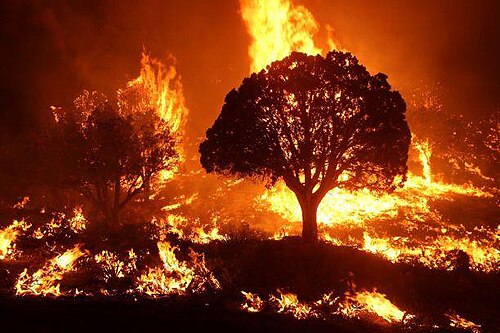
Wildfires are usually described through what can be seen: flames, smoke, burnt vegetation, road closures and evacuation orders.
But the most significant damage may be below the surface.
Across Wales, scientists investigating severe fires during the summer of 2026 have warned that the visible blackened landscape is only part of the story. At one site in Conwy, researchers estimate that around 10 centimetres of topsoil may have been lost—a layer containing organic matter built up over thousands of years.
That loss matters because soil is not merely the ground beneath a landscape. It is a carbon store, a water-retention system, a nutrient bank, a habitat and a natural defence against erosion and flooding.
When severe fire damages or removes it, the consequences extend well beyond biodiversity.
For businesses, investors, insurers, local authorities, landowners and infrastructure planners, wildfire should increasingly be treated as a compound resilience risk with implications for climate targets, water management, supply chains, asset values and restoration costs.
The hidden carbon loss
Vegetation can sometimes recover relatively quickly after a fire. Green shoots may appear within weeks or months.
Soil is different.
Organic-rich topsoil often contains carbon accumulated through plant growth, decomposition and microbial activity over long periods. Fire can release some of that carbon to the atmosphere directly. It can also destroy the soil structure and biological processes needed to retain carbon in future.
The risk is particularly acute in upland, heathland, grassland and peat-influenced environments where soils can serve as important carbon stores.
A severe fire can therefore create a damaging feedback loop:
Heat and drought→higher wildfire risk→soil and carbon loss→weaker ecosystem resilience→greater future fire and erosion risk
The carbon impact is only one part of the problem. Once soil structure is damaged, rainfall can wash away remaining material.
Water repellency can increase. Nutrients can be lost. Habitats can become less capable of regenerating. Downstream rivers, reservoirs and water-treatment systems may face higher sediment loads.
This is why a landscape may appear to be recovering while still carrying deep, long-term ecological and financial damage.
Wildfire is a physical-risk issue
Climate-risk assessments often focus on flooding, heatwaves, drought, sea-level rise and extreme storms. Wildfire deserves equal attention—particularly where land, infrastructure, housing, utilities, tourism, agriculture, forestry or supply chains are exposed.
For an organisation with physical assets near fire-prone land, the consequences may include:
Property damage and business interruption
Electricity, telecommunications and transport disruption
Smoke-related health and workforce impacts
Higher insurance costs or reduced insurance availability
Loss of ecosystem services, including water regulation
Restoration, remediation and erosion-control costs
Reputational exposure where land stewardship or nature claims are involved
Reduced reliability of nature-based carbon projects and biodiversity commitments
For investors and lenders, wildfire risk can change the expected value and resilience of land, timber, agricultural operations, property portfolios and infrastructure corridors.
For companies procuring nature-based carbon credits, the lesson is even more direct. A project’s carbon value depends on ecosystem durability. If a site is highly exposed to drought, fire, pests or weak land governance, those risks need to be assessed, monitored and reflected in both pricing and climate claims.
Soil is infrastructure
The phrase “natural capital” can sometimes feel abstract. Soil makes it concrete.
Healthy soil absorbs and stores water. That can reduce runoff, support vegetation during dry periods and improve resilience to heavy rainfall. It stores carbon. It supports food production. It filters water. It sustains biodiversity.
When topsoil is lost, communities may face a combination of higher flood exposure, poorer water quality, more expensive land restoration and slower ecosystem recovery.
This is why soil should be viewed as infrastructure.
A local authority planning wildfire prevention, a water company protecting catchments, an insurer assessing regional exposure, or a business sourcing agricultural commodities all have a stake in how soils are managed before and after fire.
The most effective resilience strategies will connect land management, fire preparedness, climate adaptation, biodiversity restoration and financial planning.
Why prevention is more valuable than restoration
Post-fire restoration is essential, but it is not a substitute for prevention.
Some soils take centuries or millennia to form. Once a deep organic layer has been burned or washed away, it cannot simply be rebuilt through planting alone. Restoration may require erosion controls, re-vegetation, long-term monitoring, invasive-species management, hydrological work and carefully designed soil interventions.
Those programmes can be costly and uncertain.
Prevention strategies should therefore focus on reducing ignition risk, improving landscape management, supporting local fire services, restoring degraded peatlands and wetlands, managing fuel loads where appropriate, and strengthening early-warning systems.
The right approach will vary by landscape. It should be evidence-led and developed with land managers, ecologists, communities, emergency services and local authorities.
One-size-fits-all solutions are unlikely to work.
A practical wildfire-resilience checklist
Businesses and asset owners do not need to own large areas of land to be exposed to wildfire. The following actions provide a proportionate starting point.
Map exposure.
Identify sites, suppliers, critical infrastructure, transport routes and land assets located in wildfire-prone areas.
Assess business dependencies.
Understand how fire could affect water supply, electricity, access routes, operations, workforce health, agricultural supply or service continuity.
Review insurance assumptions.
Ask whether existing cover, deductibles, exclusions and business-interruption assumptions remain appropriate under higher wildfire risk.
Build wildfire into nature and carbon due diligence.
For land investments, natural-capital projects and carbon-credit procurement, evaluate fire history, drought exposure, restoration capacity, buffer arrangements and long-term monitoring.
Strengthen emergency plans.
Ensure continuity plans address evacuation, smoke exposure, staff communications, supplier disruption and alternative operating arrangements.
Support prevention and restoration partnerships.
Businesses can work with local authorities, water companies, land managers and community organisations to support landscape resilience where they operate or source materials.
The strategic lesson
The Welsh research is a reminder that climate damage often accumulates outside the visible event.
A wildfire may last days. The loss of soil carbon, water-retention capacity and ecological resilience can last decades—or longer.
For corporate climate strategy, this reinforces an important principle: resilience cannot be measured only through emissions inventories. It must also consider the physical systems that sustain assets, communities and supply chains.
The organisations best prepared for a hotter, drier and more volatile climate will be those that treat healthy landscapes and soils as part of their operating environment—not as scenery beyond the business boundary.