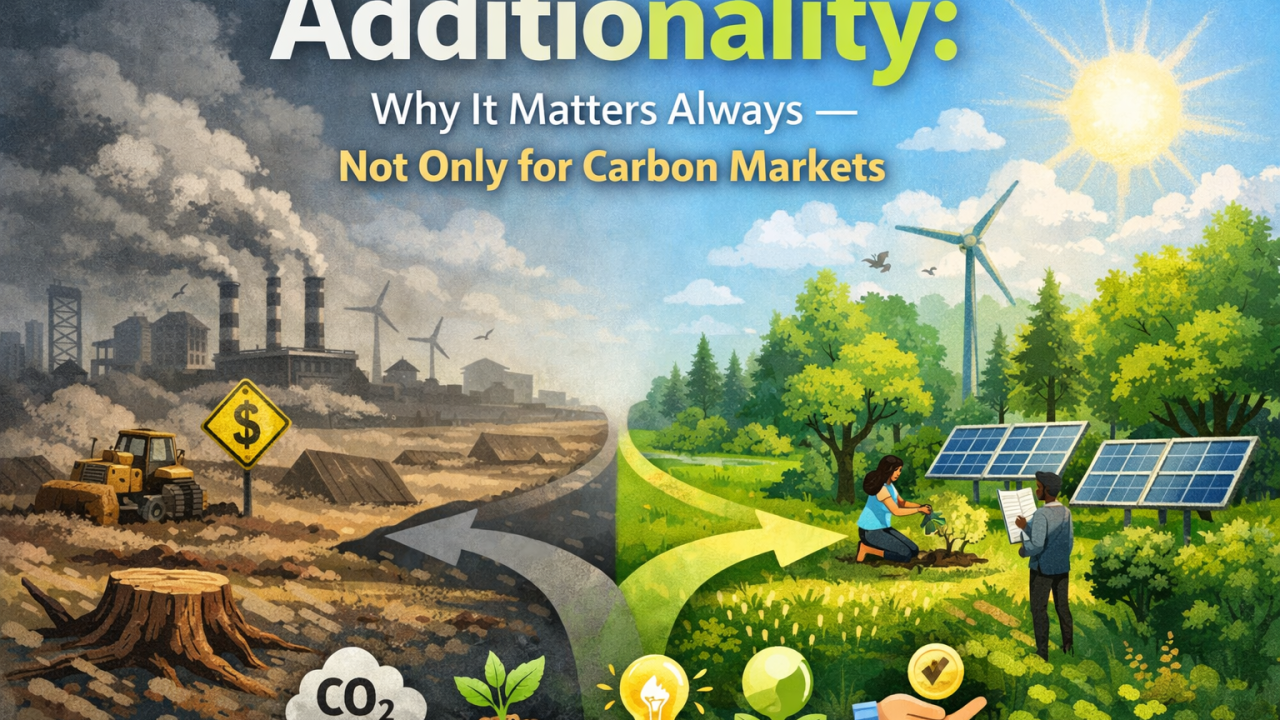
For years, carbon markets have been defined by a simple unit: one tonne of carbon dioxide equivalent.
A project reduces, avoids or removes greenhouse gases. A methodology estimates the climate benefit. A credit is issued. A buyer purchases and retires it. The buyer may then make a claim.
This model has created a large and often controversial market. It has also encouraged a narrow view of value.
The future of carbon markets may not be decided solely by carbon.
That is the central argument of a recent Oxford Martin School analysis by Olivier Mahul, a financial economist and expert in climate and risk finance. The article argues that carbon markets can become more useful if they are designed not only to pay for emissions outcomes, but to support resilience, risk reduction and wider development benefits.
The point is not that carbon measurement no longer matters. It matters enormously.
The point is that a carbon market that ignores resilience, land rights, local livelihoods, adaptation and distributional outcomes may struggle to maintain legitimacy—even if the accounting is technically sound.
The next carbon-market model must be built around climate value, not tonnes alone.
The problem with a carbon-only market
A carbon credit is attractive because it appears to simplify a complex problem.
Climate mitigation becomes measurable. Buyers can compare projects. Capital can move across borders. Governments and companies can identify lower-cost opportunities to reduce emissions.
But climate projects are rarely only about carbon.
A forest-restoration project affects land use, biodiversity, water, food production, jobs and local rights. A clean-cooking project affects household health, fuel costs, women’s time, forest pressure and energy access. A regenerative-agriculture project affects soil, yields, resilience, farmers’ income and food systems. A coastal-blue-carbon project affects fisheries, flood protection, biodiversity and community livelihoods.
When markets measure only tonnes, they may undervalue these wider benefits. Worse, they can create incentives that conflict with local priorities.
The recent debate around carbon forestry in New Zealand illustrates the issue. Reuters reported that the expansion of carbon forestry and tradable credits has increased competition for land used by sheep and beef farming, raising concerns about rural communities, local employment and land-use change.
A project can generate a real carbon benefit and still create difficult social or economic consequences.
That does not mean carbon markets should be abandoned. It means their design needs to become more sophisticated.
From carbon finance to climate-risk finance
Climate risk is not distributed evenly.
Floods, droughts, heat, crop failure, water stress, wildfire and storm damage affect countries, regions and households differently. The people most exposed to these risks often have the least access to insurance, public support or investment capital.
Carbon markets can potentially help address this gap if they are designed to mobilise finance for actions that reduce both emissions and vulnerability.
For example:
Restoring mangroves can store carbon while reducing coastal flood risk.
Improving soil health can support carbon outcomes while increasing drought resilience.
Clean-cooking programmes can reduce emissions while improving health and reducing fuel costs.
Agroforestry can create carbon benefits while diversifying farm income.
Watershed restoration can improve ecosystem function while reducing water-related risk.
These are not automatic outcomes. They depend on project design, local participation, credible safeguards and benefit-sharing.
But they point to a broader opportunity: carbon finance can become part of climate-risk finance.
This would change the question buyers ask.
Instead of asking only, “How many tonnes does this project generate?”, they would also ask:
Does the project reduce physical climate risk?
Who benefits from the revenue?
Does it strengthen local livelihoods?
Does it protect or restore nature?
Are benefits durable under climate stress?
Does it improve resilience for people who face the greatest exposure?
Why insurance and risk transfer matter
Risk finance is one of the least discussed parts of climate action.
Insurance, contingent finance, catastrophe bonds, resilience bonds and other tools can help communities and businesses recover after shocks. But many vulnerable regions and households remain underinsured or uninsured.
Carbon markets could potentially support risk-finance solutions in several ways.
Revenue from carbon projects could help fund community resilience programmes.
Project structures could include insurance mechanisms that protect participants against climate-related reversal or livelihood losses. Governments could use carbon-market income to strengthen adaptation funds. Buyers could support portfolios that combine mitigation, removals and resilience outcomes.
This does not mean every carbon credit should become an insurance product.
It means carbon markets should recognise that permanence and additionality are not the only risks that matter. Physical climate risk, social risk and delivery risk are linked.
A forest project threatened by wildfire is not only a carbon-reversal risk. It may also be a livelihood, biodiversity and water-security risk. A project that helps communities manage these risks may be more durable and more valuable than one that focuses narrowly on carbon accounting.
Local benefit-sharing is central to integrity
Carbon markets have often struggled with questions of fairness.
Who owns the land? Who has the right to sell the carbon? Who receives the revenue? Who bears the restrictions? Who is consulted? Who has access to dispute resolution? Who remains accountable if the project fails?
These questions are not separate from integrity. They are part of it.
A project that excludes local people, concentrates benefits or creates conflict may face operational disruption, legal challenge, reputational damage or eventual failure. A project that shares benefits clearly and supports local priorities is more likely to endure.
Good benefit-sharing can include:
Direct payments to landowners, farmers or community institutions.
Employment and local procurement.
Community-controlled funds.
Investment in water, health, education or energy access.
Transparent revenue-sharing agreements.
Participatory governance.
Accessible grievance mechanisms.
Independent monitoring of social and environmental outcomes.
The right structure will vary by context. The principle is consistent: carbon revenue should not flow past the communities who make the climate outcome possible.
Measuring more without creating impossible complexity
A common objection is that adding resilience, biodiversity and social outcomes will make carbon markets too complicated.
That risk is real.
Markets need clear, comparable and credible methods. If every project uses a different set of indicators, buyers may struggle to assess quality and projects may face excessive monitoring costs.
The solution is not to ignore co-benefits. It is to create proportionate and transparent frameworks.
A practical approach could involve three levels of assessment:
Core carbon integrity
Additionality, baseline, quantification, monitoring, permanence, leakage and verification.Safeguards and risk management
Land rights, free and informed participation, grievance mechanisms, biodiversity risks, community impacts and climate-resilience planning.Optional high-integrity outcomes
Verified resilience, biodiversity, livelihood or adaptation indicators that buyers can support and report separately.
This structure would prevent projects from making vague claims about “co-benefits” while avoiding the mistake of treating every project as a full development programme.
The role of buyers
Corporate buyers have significant influence over the direction of the market.
If they demand only the lowest price per tonne, projects will be incentivised to minimise cost. If they demand credible evidence of durability, local benefits, safeguards and resilience, the market will begin to reward those qualities.
This is not philanthropy. It is risk management.
Projects with stronger local relationships, more resilient land-management practices and clearer benefit-sharing may be less exposed to reversal, conflict and reputational damage. They may also be more likely to deliver their promised outcomes over time.
For buyers, a better procurement process should ask:
What is the project’s carbon methodology?
How is physical climate risk assessed?
How are local communities involved?
What benefits are shared, and how is this documented?
What happens if the project faces drought, fire, flooding or market disruption?
Are biodiversity and land-use impacts monitored?
How does the project fit within the buyer’s wider decarbonisation strategy?
Carbon credits should not be treated as a substitute for reducing value-chain emissions. But where companies choose to finance climate action beyond their value chain, they should choose projects that create durable and equitable value.
Carbon markets need a broader social contract
The future of carbon markets will depend on public trust.
That trust will not come from a new label alone. It will come from evidence that projects are scientifically credible, economically fair and socially legitimate.
Carbon remains the core unit because the climate challenge requires measurable emissions reductions and removals.
But carbon is not the only outcome that matters.
The markets that succeed will be those that understand a tonne of CO₂ is embedded in a wider system of land, livelihoods, ecosystems, infrastructure and risk.
The next generation of carbon finance should not ask communities to choose between climate action and resilience. It should help deliver both.