Shipping faces a difficult decarbonisation challenge.
Vessels have long operating lives. Many are designed around fuels and engine systems that cannot be replaced quickly. Low-emissions fuels such as green methanol, ammonia, hydrogen and advanced biofuels are developing, but availability, cost, safety and infrastructure remain constraints.
This has created interest in onboard carbon capture and storage, often referred to as OCCS.
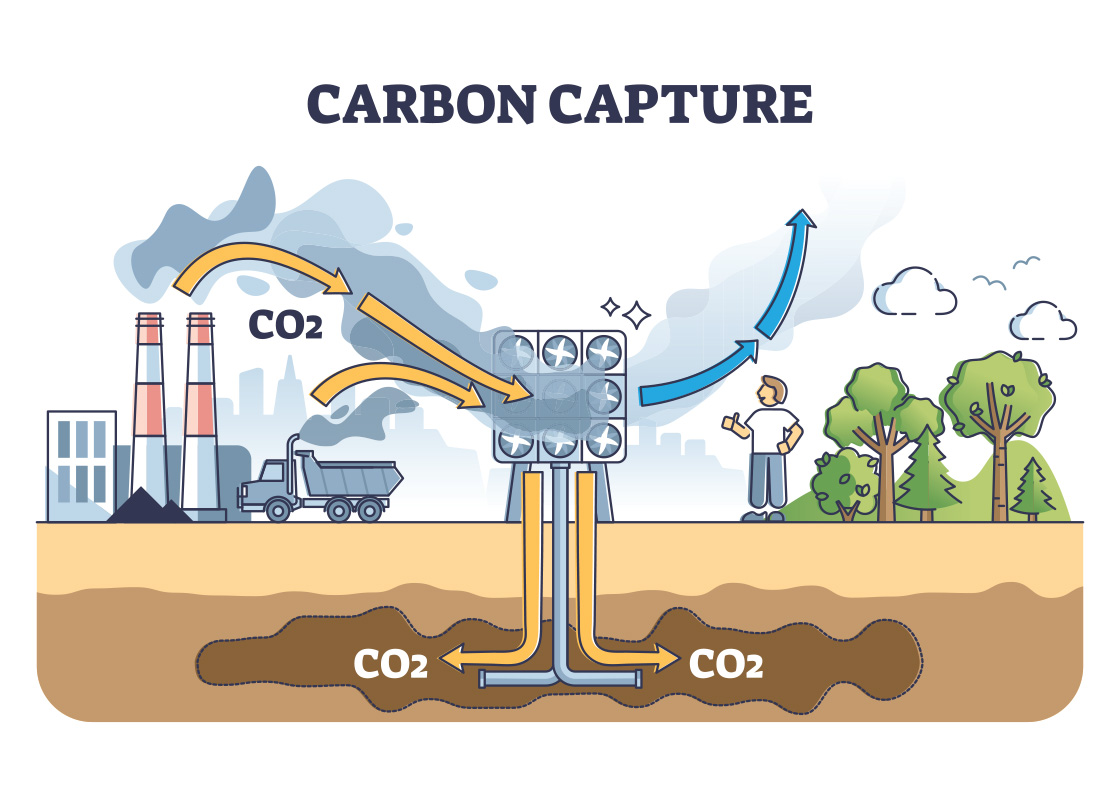
The concept is simple.
A ship captures CO₂ from its exhaust gas before it enters the atmosphere, compresses or liquefies it, stores it temporarily on board and later offloads it for transport, utilisation or permanent storage.
In practice, the system is far from simple.
A recent industry discussion from Carbon Ridge argues that retrofitted capture systems could help existing vessels meet tightening emissions requirements and extend asset life. The company’s system reportedly removes CO₂, sulphur compounds and nitrogen oxides from flue gas before compressing and storing captured CO₂ on board.
The potential is real.
But the relevant question is not how much CO₂ a system captures at the stack.
It is how much greenhouse-gas reduction remains after the energy, fuel, logistics and storage chain are fully accounted for.
How onboard capture works
An onboard capture system typically involves several stages.
Exhaust-gas conditioning
The exhaust stream may require cooling, cleaning or pre-treatment. Sulphur oxides, nitrogen oxides, particulates and water can affect capture performance and equipment durability.
CO₂ separation
The system separates CO₂ from the exhaust gas using a technology such as chemical absorption, adsorption, membranes, cryogenic separation or mineralisation.
Regeneration or processing
For many systems, the capture medium must be regenerated using heat or electricity. This is one of the major sources of energy demand.
Compression and storage
Captured CO₂ must be compressed or liquefied, then stored in tanks on board. This adds weight, space requirements and operational complexity.
Offloading and final management
At port, the CO₂ must be transferred safely to a reception facility. It may then be transported for geological storage, mineralisation or utilisation.
Each stage affects the final climate result.
Gross capture is not net abatement
A system may report a 50% or 90% capture rate at the exhaust stream.
That does not mean it reduces a vessel’s lifecycle greenhouse-gas emissions by 50% or 90%.
The net climate benefit must account for:
Net GHG reduction=gross CO₂ captured−additional fuel emissions−capture-energy emissions−compression and storage emissions−offloading and transport emissions−final-storage or utilisation emissions
If a capture system requires additional fuel, the vessel produces more exhaust to operate it. If the captured CO₂ is later released, the climate benefit may be temporary or limited. If transport or storage relies on carbon-intensive energy, the net benefit is reduced.
This is why lifecycle assessment is essential.
The International Maritime Organization’s work on OCCS explicitly recognises this point. The IMO is developing a regulatory framework intended to ensure that onboard capture reduces net greenhouse-gas emissions without creating harmful air or sea discharges. Its work programme includes testing, survey, certification, CO₂ record-keeping, reception facilities, lifecycle accounting and the traceability of captured carbon through to final storage or utilisation.
CO₂ storage capacity is a commercial constraint
A ship does not have unlimited space.
CO₂ storage tanks can compete with cargo space, fuel capacity or other equipment. The volume required depends on fuel consumption, capture rate, CO₂ density and voyage length.
This creates practical questions:
How much CO₂ can the vessel store before offloading?
How frequently must the ship access CO₂ reception facilities?
Does the system reduce cargo capacity or operational flexibility?
Can ports receive and handle CO₂ safely?
Who owns the CO₂ after offloading?
Who bears the cost of transport and permanent storage?
For short routes with regular port calls, onboard capture may be more manageable.
For long-haul shipping, storage capacity and reception infrastructure may be greater constraints.
The economics will vary by vessel type, route, fuel, port network and regulatory exposure.
Captured CO₂ needs a credible destination
The final destination of captured CO₂ is central.
There are three broad pathways.
Permanent geological storage
CO₂ is injected into a suitable underground formation and monitored over the long term. This can provide durable storage if the site is properly selected, regulated and managed.
Mineralisation
CO₂ is chemically bound into stable materials, such as carbonates. The climate value depends on the permanence of the resulting material and the lifecycle emissions of the process.
Utilisation
CO₂ may be used in fuels, chemicals, food and beverage applications or other products. Some uses store carbon only temporarily. If the CO₂ later returns to the atmosphere, the climate benefit must be accounted for accordingly.
The key principle is simple.
CO₂ should not receive a permanent emissions-reduction credit unless it is permanently stored or transformed in a way that demonstrably prevents its later release.
Regulation is catching up
The IMO’s work on onboard capture is important because shipping requires international rules.
A vessel may be registered in one country, fuelled in another, operated across multiple jurisdictions and offload CO₂ in a different port. Without common standards, it is difficult to verify performance or prevent double counting.
The IMO’s OCCS work programme is scheduled to continue through 2028. It includes development of a regulatory framework for capture systems, safe handling, certification, data recording and the treatment of captured CO₂.
The EU Emissions Trading System is also relevant.
A maritime pilot known as Project CAPTURED has demonstrated that onboard-captured CO₂ can be recognised under the EU ETS when it is permanently bound through eligible mineralisation pathways. The project reported a 10.7% gross capture rate and a 7.9% net greenhouse-gas reduction after lifecycle assessment.
That difference is instructive.
Gross capture was higher than net abatement because the full chain consumes energy and creates additional emissions.
This is precisely why net accounting matters.
Where onboard capture may fit
Onboard capture is unlikely to be a universal solution.
It may be most relevant for:
Existing vessels with long remaining asset lives
Ships operating on routes with access to CO₂ offloading infrastructure
Vessels unable to secure low-emissions fuel in the near term
Operators facing regulatory costs under the EU ETS or similar systems
Ships with suitable space, power and heat integration options
Transitional applications where the alternative is continued high-emissions operation
It may be less attractive where low-emissions fuels are readily available, vessels are close to retirement or storage logistics are impractical.
The technology should therefore be assessed vessel by vessel, route by route and fuel by fuel.
A retrofit is not automatically a climate solution
Retrofit can extend the operating life of existing assets.
That can be commercially rational and, in some cases, climate-positive. Replacing every vessel immediately would create its own embodied-carbon and capital challenge.
But retrofitting also creates the risk of delaying investment in genuinely low-emissions fuels and ship designs.
The answer is not to reject onboard capture automatically.
It is to apply a clear test.
Does the retrofit deliver verified net emissions reductions compared with the realistic alternative? Does it have a credible CO₂ offloading and storage pathway? Does it avoid pollution transfer from air to sea? Does it support, rather than delay, long-term maritime decarbonisation?
If the answer is yes, onboard capture may be a useful bridge.
If the answer is no, it may become an expensive form of emissions accounting.
The full-chain test
The future of shipping decarbonisation will involve multiple pathways.
Efficiency improvements, wind assistance, shore power, battery systems, low-emissions fuels, green corridors and new vessel designs will all play roles.
Onboard carbon capture may also play a role.
But it should be judged by the same standard as every other climate technology:
Not whether it sounds innovative.
Not whether it captures carbon at one point in the system.
But whether it delivers durable, verifiable and net greenhouse-gas reductions from fuel tank to final storage.