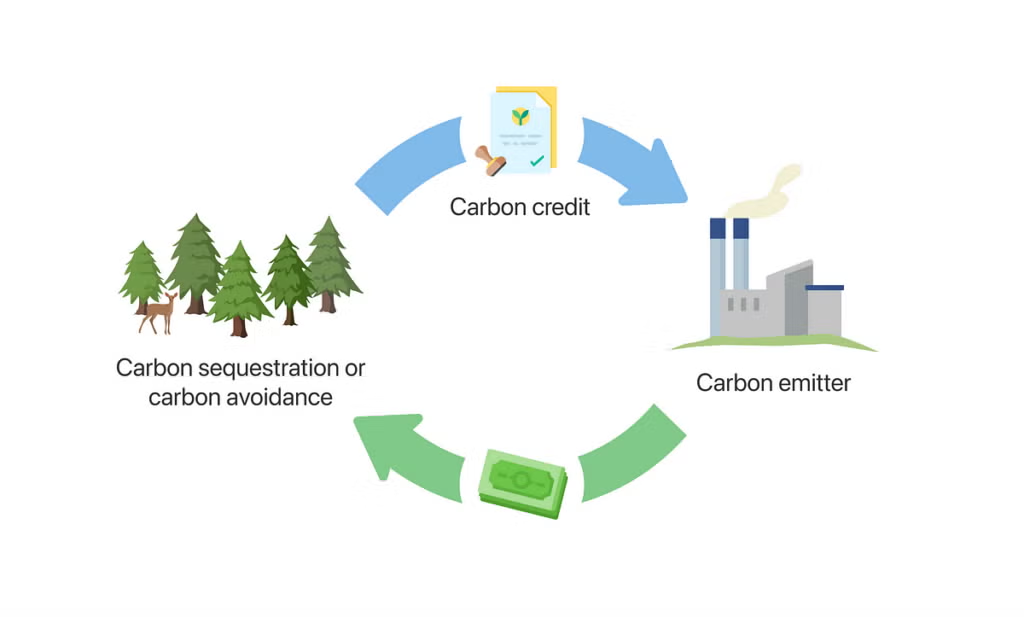
Nature-based carbon markets are entering a more demanding phase.
For much of the market’s early development, projects were often presented through simple and compelling narratives: protect a forest, plant trees, restore a landscape, generate credits and channel finance toward nature.
The underlying proposition remains important. Protecting and restoring ecosystems can deliver climate benefits while supporting biodiversity, water security, livelihoods and resilience.
But the market has learned that good intentions are not enough.
A project may look compelling on a map yet deliver weak climate outcomes if its baseline is overstated, harmful activity shifts elsewhere, carbon gains are reversed by fire or drought, or local people are excluded from decision-making and benefits.
The next generation of nature-based credits is therefore being defined less by acreage and more by evidence.
A recent World Economic Forum assessment argues that next-generation projects are strengthening carbon accounting through more conservative methods, dynamic baselines, leakage controls, durability planning and new technologies for measurement, monitoring and verification. It also points to the growing importance of local participation and benefit-sharing in building credible projects.
For companies buying credits, investors financing projects and land managers developing them, this marks a meaningful change.
The central question is no longer: “How many tonnes can this project issue?”
It is: “Can this project demonstrate real, additional and durable climate value while creating legitimate value for the people and ecosystems connected to it?”
The market is moving beyond simple narratives
Nature-based projects face a uniquely difficult task.
They must quantify carbon in biological systems that change over time. Forests grow, burn, are harvested, recover and respond to weather. Soils vary substantially across a single landscape. Coastal habitats can be highly productive carbon stores, but they are affected by hydrology, erosion, storms and land-use pressures.
This does not make nature-based solutions unsuitable for carbon finance. It means the market must be careful about what is claimed, how it is measured and how uncertainty is handled.
The strongest projects now recognise that a carbon credit is not simply a calculation. It is a long-term commitment to manage risk.
Four changes are particularly important.
1. More conservative carbon accounting
The credibility of a credit begins with the counterfactual: what would have happened without the project?
If a baseline assumes that a forest would certainly have been cleared, but deforestation pressure was already falling, the project could receive credits for reductions that were not truly additional. If a restoration project uses optimistic assumptions about future growth, it may issue credits before the carbon benefit is secure.
Next-generation approaches aim to reduce this risk by using:
More conservative assumptions
Dynamic rather than static baselines
Better regional comparison data
Explicit uncertainty deductions
Independent validation and verification
Ongoing reassessment as conditions change
Conservatism may reduce the volume of credits issued in the short term. But it can increase confidence in the credits that remain.
That is the direction a mature market should take.
A high-integrity credit should not be the largest number a project can justify. It should be the most credible number it can defend.
2. Leakage and permanence need active management
Two risks have long shaped scrutiny of nature-based credits.
The first is leakage: a project protects one area, but the activity it was intended to prevent simply moves somewhere else. For example, restricting forest clearance in one location may shift agricultural expansion to another.
The second is permanence: carbon stored in vegetation or soils may later return to the atmosphere through fire, disease, drought, storms, illegal clearance or changes in land management.
Neither risk can be eliminated entirely. The practical challenge is to identify, reduce, monitor and financially manage it.
Credible projects increasingly use tools such as:
Landscape-level leakage assessments
Fire monitoring and management plans
Buffer pools and risk reserves
Long-term land agreements
Diversified restoration approaches
Community-led stewardship
Adaptive management plans
Clear arrangements for reversal liability
The purpose is not to promise that nature will never change. It is to show that risk has been recognised and managed transparently.
For buyers, a permanence strategy should matter as much as the project’s headline carbon number.
3. Technology can strengthen evidence—but not replace judgement
The quality of environmental data has improved significantly.
Satellite imagery, LiDAR, drone surveys, remote sensing, mobile data collection, machine learning and geospatial analytics can help project developers monitor land cover, biomass, fire risk, hydrology and change over time.
These tools can make monitoring more frequent, lower-cost and more transparent. They can also help buyers and third parties identify discrepancies between a project’s claims and observable conditions on the ground.
But technology is not a substitute for governance.
A satellite can show a change in tree cover. It cannot, by itself, determine whether local people gave meaningful consent, whether benefits are fairly shared, whether a project is causing harm or whether a claimed outcome is genuinely additional.
The strongest projects combine digital monitoring with:
Ground-truthing
Local ecological knowledge
Clear grievance mechanisms
Independent assurance
Transparent data disclosure
Long-term stakeholder engagement
Technology should make claims more testable. It should not make them less accountable.
4. Communities are not an add-on
Nature-based projects operate in real places, often on land that communities live on, depend on or hold cultural connections to.
That means local rights and benefits are not optional social enhancements. They are core to durability.
A project that excludes local people may face conflict, loss of trust, weak long-term stewardship and eventual reversal risk. A project that builds meaningful partnerships can create more resilient outcomes for carbon, biodiversity and livelihoods.
Buyers should ask:
Who holds land and resource rights?
Who participated in project design?
How are revenues shared?
What benefits are guaranteed rather than merely anticipated?
Is there a credible grievance process?
How are women, young people and marginalised groups represented?
What happens when project priorities conflict with local needs?
The answers should influence investment decisions.
A credit cannot be considered high integrity if the project producing it is socially fragile.
What buyers should look for now
As the market changes, buyers need to move beyond broad labels such as “nature-based” or “high quality.”
A practical due-diligence process should examine five areas.
Carbon integrity
Is the baseline credible and conservative?
Is additionality clearly demonstrated?
How are uncertainty and leakage treated?
What is the project’s approach to reversals and buffer pools?
Durability
What are the major physical risks?
How are wildfire, drought, flooding, pests and land-use change managed?
What legal and financial arrangements support long-term stewardship?
Nature outcomes
Does the project protect or restore ecological function?
Are biodiversity outcomes measured rather than assumed?
Are monoculture approaches being avoided where inappropriate?
Social legitimacy
Are rights, participation and benefit-sharing documented?
Is there independent evidence of meaningful local engagement?
Can communities raise concerns safely and effectively?
Transparency
Are methods, monitoring results and material risks accessible?
Can claims be independently scrutinised?
Are setbacks, reversals and corrective actions reported openly?
The strongest projects will not necessarily be the ones with the most polished marketing. They will be the ones prepared to show their workings.
The future is portfolio thinking
Nature-based credits should not be treated as a homogeneous commodity.
A tonne associated with avoided deforestation, peatland restoration, mangrove recovery, agroforestry or soil-carbon improvement can involve very different assumptions, co-benefits and risk profiles.
This means companies should avoid simplistic procurement strategies based only on volume or price.
Instead, they should build portfolios that consider:
Project type
Geography
Reversal risk
Community context
Monitoring maturity
Delivery timing
Biodiversity value
Carbon-storage durability
Strategic fit with their own climate transition plan
The goal is not to find a perfect credit. It is to make informed decisions, disclose limits honestly and direct capital toward projects that can withstand scrutiny.
A market built on proof
Nature-based solutions remain indispensable.
They can protect ecosystems, improve resilience, support biodiversity and unlock finance for landscapes that are otherwise undervalued. But the future of the market will depend on whether buyers, standards bodies, developers and policymakers accept a higher bar.
The next generation of credits will not be defined by more ambitious stories.
It will be defined by more credible evidence.
That means conservative accounting, better monitoring, active risk management, durable governance and meaningful local benefit.
In other words, the future of nature-based carbon markets will be built on proof—not acreage.