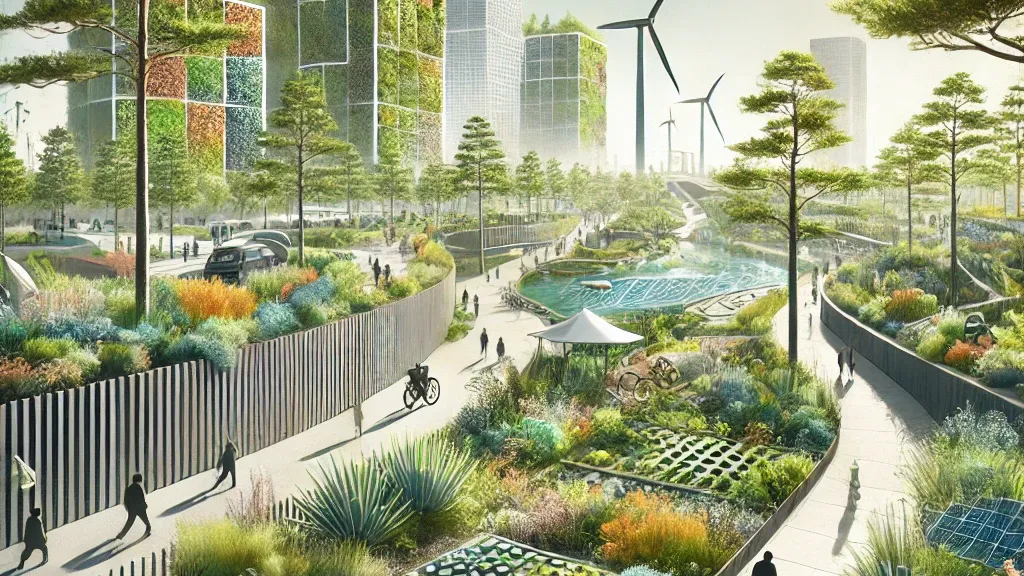
Planting trees is one of the most visible symbols of environmental action.
A new park, green corridor, urban square, school landscape or development masterplan often features ambitious images of trees, wetlands, wildflower meadows and green space.
Those features can provide real benefits.
They can support biodiversity, reduce heat stress, improve wellbeing, manage water, create shade, enhance local character and—in some cases—store carbon.
But a landscape is not automatically low carbon because it is green.
The construction of parks and public realm can involve concrete, steel, paving, imported soil, drainage systems, lighting, irrigation, transport, heavy machinery and long-term maintenance. Large quantities of carbon can be emitted before a newly planted tree has had time to absorb meaningful amounts.
This is why a new site-carbon assessment standard from the American Society of Landscape Architects is important. It aims to bring trees, soils, materials, construction and maintenance into the same carbon equation.
The principle is broadly relevant far beyond the United States.
For developers, architects, local authorities, investors, contractors and landowners, landscape carbon needs to be managed as a whole-system issue.
The missing carbon account
Landscape carbon is often fragmented across different disciplines.
An ecologist may measure habitat value. An arborist may assess trees. A civil engineer may design drainage. A landscape architect may specify materials. A contractor may manage plant and equipment. A facilities team may maintain the site for decades.
Each role is important.
But if no one brings the carbon impacts together, decision-makers can miss the full picture.
A project may claim carbon benefits because it includes hundreds of new trees, while also involving extensive excavation, high-carbon retaining walls, imported aggregates, frequent irrigation, hard paving and high-maintenance planting.
The project may still be worthwhile. But it should be assessed honestly.
A whole-site carbon account can include:
Existing trees and vegetation
Soil carbon and soil disturbance
Imported or removed soil
Concrete, steel, paving, timber and other materials
Drainage, utilities, lighting and irrigation
Construction machinery and transport
Planting, maintenance and replacement
Water use and operational energy
End-of-life, reuse and future adaptation
Carbon sequestration from vegetation over time
This approach recognises that landscape is both ecological infrastructure and built infrastructure.
Soil is often the largest overlooked factor
Trees receive attention because they are visible and easy to communicate.
Soils are less visible, but they can be equally important.
Healthy soils store carbon, retain water, support plant growth and help reduce erosion. Disturbing soils through excavation, compaction, drainage, removal or replacement can release carbon and weaken ecosystem performance.
In development projects, soil is often treated as waste or as a material to be moved off site and replaced with imported products.
That can create avoidable emissions from transport and reduce the landscape’s ability to support long-term planting.
A better approach is to treat soil as an asset.
Before work begins, project teams should understand:
Existing soil depth and condition
Organic-carbon content where relevant
Contamination and remediation requirements
Opportunities to retain and reuse soil on site
Risks from compaction and drainage changes
The water needs of future planting
Whether proposed landscaping can survive under future climate conditions
This links directly to the wider resilience agenda. A landscape that preserves healthy soil can be more capable of absorbing heavy rainfall, retaining moisture during drought and supporting vegetation through heat stress.
Carbon, biodiversity and resilience should not compete
There is a risk that carbon measurement becomes another narrow metric that sidelines biodiversity or community value.
That would be a mistake.
The aim is not to maximise carbon at the expense of people, access, safety, beauty or ecological diversity.
The aim is to understand trade-offs and identify choices that create multiple benefits.
A well-designed landscape can support:
Carbon storage in vegetation and soils
Urban cooling and reduced heat exposure
Flood mitigation and water management
Biodiversity habitat and ecological connectivity
Health, recreation and community wellbeing
Lower maintenance requirements
More resilient public spaces
Improved property value and amenity
The strongest schemes will use carbon data alongside biodiversity metrics, water analysis, social-value assessment and lifecycle-cost analysis.
This creates a more complete investment case.
Material choices still matter
Landscape architecture often relies on high-volume materials.
Paving, concrete, steel, stone, timber, geotextiles, drainage products, street furniture and lighting can all contribute to a project’s upfront carbon footprint.
Project teams should ask practical questions:
Can existing materials be retained or reused?
Is there a lower-carbon alternative to concrete-intensive design?
Can recycled aggregates or reclaimed paving be used?
Is the proposed material durable enough to avoid frequent replacement?
Does a supplier provide credible product-level environmental data?
Can planting and soil strategy reduce the need for irrigation or chemical inputs?
Can future repairs be made without major demolition?
The answer will vary by site. Public safety, durability, accessibility and budget all matter.
But carbon needs to be part of the decision, not an afterthought.
A site carbon-management process
A proportionate carbon-management process for landscape projects can follow five stages.
1. Establish the baseline.
Measure existing vegetation, soil condition, site materials and likely demolition or clearance impacts.
2. Compare design options.
Test alternatives for materials, grading, drainage, planting, reuse and construction methods before the design is fixed.
3. Set carbon and resilience objectives.
Agree measurable targets for upfront carbon, retained materials, soil protection, planting survival, water use and biodiversity value.
4. Manage delivery risk.
Require suppliers and contractors to provide material evidence, transport assumptions, construction data and change-control information.
5. Monitor the operational landscape.
Track planting survival, irrigation, maintenance inputs, replacement rates, water use and site performance over time.
As with buildings, the value of carbon measurement lies in using it before choices become expensive to reverse.
Why this matters to business
Landscape carbon may sound like a specialist design topic.
It is increasingly a business issue.
Developers face planning, investor and occupier pressure to show credible environmental performance. Local authorities need public spaces that are resilient to heat and flooding. Infrastructure projects must manage biodiversity, community impact and material emissions. Corporate campuses and industrial sites need to reduce climate risk while improving employee and community value.
For these audiences, landscape design can no longer be only a finishing layer added after the core project is complete.
It is part of the climate, nature and asset-management strategy.
The next standard for green space
Green space is valuable.
But not every green-looking project delivers the same climate outcome.
The future of sustainable land development will depend on measuring what matters:
trees, soils, materials, construction, water, maintenance, biodiversity and long-term resilience.
A landscape carbon account does not replace design judgement.
It improves it.
The question should not be “How many trees are we planting?”
It should be “What is the full carbon, nature and resilience performance of this place over time?”