For years, carbon capture and storage in Europe has been discussed as a policy ambition.
Governments have published strategies. Industrial companies have announced projects. Ports have considered future CO₂ terminals. Storage developers have mapped offshore reservoirs. Investors have debated whether the business model is bankable.
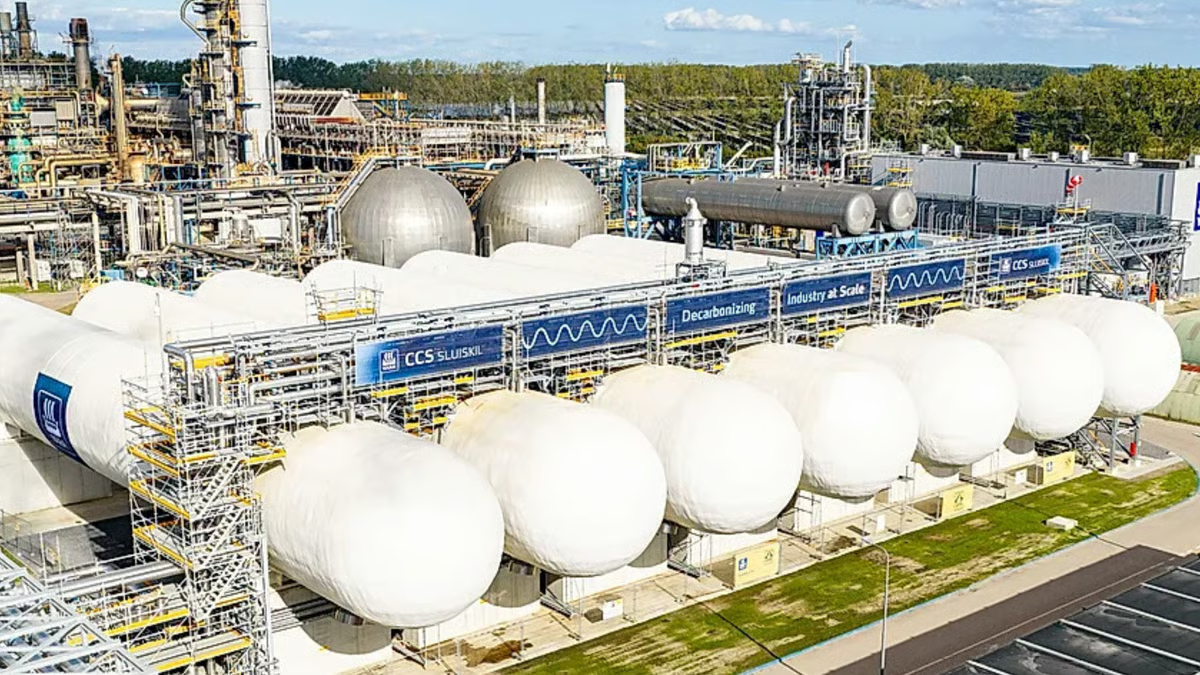
At Yara Sluiskil in the Netherlands, that discussion has now become operational.
On 7 September 2026, Yara inaugurated what the company and European Commission describe as Europe’s largest commercial industrial carbon capture and storage facility. The ammonia and fertiliser plant is designed to capture and liquefy up to 800,000 tonnes of carbon dioxide each year from ammonia production. The CO₂ will be transported by ship to Norway and permanently stored by Northern Lights around 2,600 metres beneath the seabed.
The project is expected to capture and store about 12 million tonnes of CO₂ over 15 years. That is significant in scale, but its real importance lies in what it proves: industrial carbon management is becoming a cross-border infrastructure business.
A complete carbon-management chain
The Yara Sluiskil project is not simply a capture unit attached to a factory.
It joins together five distinct parts of a carbon-management value chain:
Capture of process emissions from ammonia production.
Liquefaction and temporary storage at the industrial site.
Marine transport from the Netherlands to Norway.
Reception and injection infrastructure at the Northern Lights facility in Øygarden.
Permanent geological storage beneath the North Sea seabed.
Each part has a different owner, risk profile, permitting requirement, cost base and financing need. The result is a system rather than a standalone technology project.
That distinction matters because hard-to-abate sectors cannot rely on capture
technology alone. A cement plant, chemicals site, waste-to-energy facility or fertiliser producer may technically be able to capture CO₂, but the project only becomes viable when there is a credible way to transport, store, monitor and account for the captured carbon over the long term.
Yara’s model shows how this can work across national borders: emissions generated in the Netherlands are captured there, shipped across the North Sea and stored permanently in Norwegian geological formations. It is a practical example of the EU–Norway Green Alliance becoming physical industrial infrastructure.
Why fertiliser and ammonia matter
Ammonia and fertiliser production are central to food systems, but they are also emissions-intensive. A meaningful share of the sector’s emissions comes not only from energy consumption, but from industrial processes associated with producing ammonia.
That makes the sector a useful test case for CCS.
For some industrial activities, electrification and renewable electricity can reduce emissions substantially. But in sectors with process emissions, a credible transition is likely to require a combination of measures:
Energy efficiency and process optimisation.
Low-carbon electricity and heat.
Lower-carbon hydrogen and feedstocks.
Circular material use where possible.
Product innovation.
Carbon capture and permanent storage for residual process emissions.
The right hierarchy remains essential: companies should reduce emissions at source wherever possible. But for the emissions that remain technically difficult to eliminate, permanent storage can become part of a credible industrial pathway.
The value of Yara Sluiskil is therefore not that it makes ammonia production “zero carbon.” It is that it demonstrates how an industrial plant can materially reduce a substantial source of process emissions while maintaining production and employment in Europe.
From project to market infrastructure
The next question is whether this becomes an isolated flagship project or the early foundation of a broader European carbon-management market.
For CCS to scale, Europe needs more than successful projects. It needs a system capable of serving many emitters across multiple regions.
That system requires:
Shared CO₂ transport infrastructure, including pipelines, port terminals and vessels.
Accessible storage capacity with clear licensing and long-term monitoring arrangements.
Contracts that allocate liability among emitters, transport providers and storage operators.
Bankable revenue models that can support high upfront capital expenditure.
Clear treatment of captured and stored CO₂ under emissions trading, reporting and product-carbon rules.
Transparent measurement, reporting and verification.
Cross-border rules that allow industrial emitters to access storage outside their home country.
Public confidence that storage is permanent, regulated and environmentally robust.
The Sluiskil–Northern Lights chain is important because it demonstrates that shared infrastructure can make CCS accessible to industrial companies that do not sit directly above a suitable storage reservoir.
That could be especially relevant for industrial clusters around the North Sea, including facilities in the Netherlands, Belgium, Germany, the United Kingdom, Denmark and other European markets.
The commercial lesson: CO₂ transport is not a detail
Industrial decarbonisation projects are often assessed through a narrow technology lens: how much CO₂ can the capture equipment remove, and at what cost?
But transport and storage can determine whether the entire investment case works.
A factory may have a strong capture opportunity yet be located far from a pipeline, port or storage hub. It may face uncertainty over shipping capacity, long-term storage tariffs, cross-border approvals or liability after injection. Those issues can delay final investment decisions even where the capture technology itself is proven.
This is why CO₂ transport is becoming a strategic infrastructure question.
For industrial companies, location will increasingly influence transition options.
Facilities near developing CO₂ corridors, shipping hubs and storage networks may gain access to lower-cost decarbonisation pathways. Facilities without that access may face higher transition costs or a more limited set of technically viable options.
For investors and lenders, the question is not simply whether a company has announced a CCS project. It is whether the project has a credible route through the entire value chain: capture, compression, transport, storage, monitoring, contractual allocation of risk and durable revenue.
What companies should do now
Yara Sluiskil should prompt industrial leaders to ask a practical set of questions.
First, identify residual process emissions.
Which emissions cannot realistically be eliminated through efficiency, electrification, renewable procurement or material substitution alone?
Second, map infrastructure access.
Is the facility close to an existing or planned pipeline, port, CO₂ shipping terminal or geological storage route?
Third, assess timing against asset cycles.
Capture equipment and CO₂ transport infrastructure take years to plan, permit and build. CCS should be assessed alongside major maintenance, replacement and expansion decisions, not after they are finalised.
Fourth, build the evidence case.
Companies need robust baselines, measurement systems, engineering assumptions, emissions data and financial models before entering transport or storage negotiations.
Fifth, distinguish reduction from storage in external claims.
Captured and permanently stored CO₂ can represent a real emissions reduction. But companies should communicate the boundary, methodology, storage route and remaining emissions with precision.
Sixth, consider collaboration.
Shared hubs and networks may be more economic than isolated company projects. Industrial clusters, ports, energy companies, governments and finance providers will need to coordinate.
A new phase for industrial climate strategy
The significance of Yara Sluiskil is not that CCS removes the need for broader decarbonisation.
It does not.
Europe still needs faster deployment of renewable power, electrification, energy efficiency, circular materials, lower-carbon fuels, grid investment and demand-side flexibility. But some industrial emissions will remain difficult to eliminate quickly, particularly in sectors linked to chemicals, cement, fertiliser, refining and waste.
For those sectors, the transition depends partly on whether Europe can build credible carbon-management infrastructure at scale.
Yara Sluiskil is an important proof point. It shows that capture, cross-border transport and permanent storage can move from strategy documents into industrial operations.
The next challenge is replication.
Europe’s carbon-management market will not be built by one facility. It will be built by networks: shared transport, accessible storage, credible regulation, transparent monitoring and commercial models that make investment possible.
That is the infrastructure test now facing European industry.