Europe’s carbon-management debate has often taken place in policy papers, funding announcements and future-capacity targets. Denmark’s Greensand Future project changes the conversation.
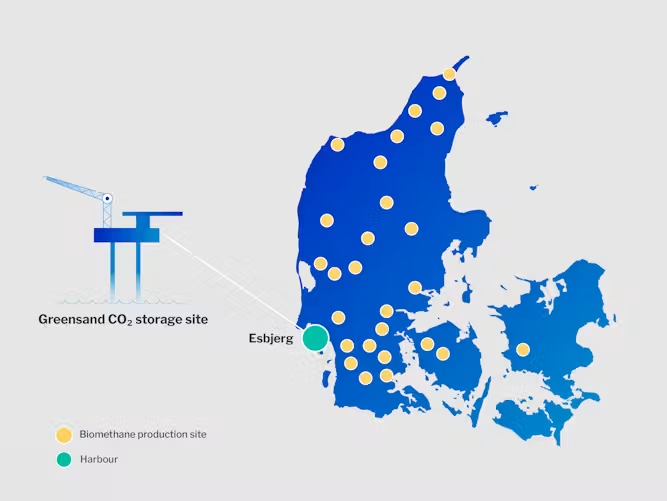
On 18 September 2026, the project entered commercial operation as what its partners describe as the European Union’s first full-scale facility for permanent CO₂ storage. Captured carbon dioxide is being liquefied, moved through the Port of Esbjerg, transported offshore and injected into the depleted Nini West oil reservoir beneath the Danish North Sea.
The initial capacity is up to 400,000 tonnes of CO₂ each year. The project partners aim to expand toward 4 million to 8 million tonnes annually as capture projects, transport infrastructure, customer demand and permits develop.
The numbers matter. But the larger significance is structural.
Greensand is not simply a storage site. It is a working carbon-management chain that links emitters, capture equipment, logistics, ports, shipping, offshore infrastructure, geological storage, monitoring and regulation. That is the kind of system Europe will need if carbon capture and permanent storage are to contribute meaningfully to industrial decarbonisation.
From capture technology to infrastructure system
Carbon capture and storage is often discussed as a single technology. In practice, it is a network.
For CO₂ to be stored permanently, several elements must work together:
An industrial or biogenic source of captured CO₂.
Equipment to separate and condition the gas.
Liquefaction or compression facilities.
Transport by pipeline, road, rail or ship.
Intermediate storage and port infrastructure.
A licensed geological reservoir.
Injection wells and offshore or onshore operating systems.
Monitoring, reporting and verification over the storage period.
Clear legal rules on liability, permitting and cross-border transport.
Greensand illustrates this chain in a practical way. The project initially receives biogenic CO₂ from Danish biomethane plants. The CO₂ is liquefied and transported to Esbjerg, then shipped on the Carbon Destroyer 1, described by the project partners as the EU’s first purpose-built CO₂ carrier. It is injected approximately 1,800 metres beneath the seabed into a depleted oil reservoir about 250 kilometres offshore.
This is a significant step because the hardest part of CCS is not always the chemistry of capturing CO₂. It is building a reliable, financeable and regulated route from multiple emission sources to a storage location.
Why biogenic CO₂ matters
The first commercial phase of Greensand focuses mainly on CO₂ from Danish biomethane production.
This matters because the climate significance of storing biogenic CO₂ depends on the full carbon cycle. Biomethane is produced from organic feedstocks. If the CO₂ separated during the upgrading process is captured and permanently stored, the result can potentially be a form of bioenergy with carbon capture and storage, often referred to as BECCS.
However, the climate claim still depends on details:
What feedstocks are used?
Would those feedstocks have generated methane or CO₂ anyway?
How are emissions from collection, transport and processing treated?
Is the storage permanent and monitored?
Who owns the carbon-removal claim?
How is double counting prevented?
The lesson for buyers and policymakers is that “biogenic” does not automatically mean “carbon negative.” The methodology, chain of custody and accounting matter.
A North Sea advantage
The North Sea gives northern Europe a potentially important advantage in carbon storage. It contains depleted oil and gas fields and saline aquifers with geological characteristics that may support long-term CO₂ storage. It also has decades of offshore engineering experience, port infrastructure and energy-sector supply chains.
But storage capacity alone does not create a carbon-management market.
Europe will need shared infrastructure, predictable regulation and contracts that allocate risk between capture operators, transport providers, storage operators and customers. It will also need public confidence that projects are safe, properly regulated and consistent with broader climate strategy.
The Greensand project is important because it demonstrates the role of maritime CO₂ transport. Not every industrial site will be connected to a pipeline. Shipping can allow dispersed emitters—such as cement plants, waste-to-energy facilities, biomethane producers and chemical sites—to access offshore storage where pipeline links are not viable.
That could be particularly relevant for the UK, Denmark, the Netherlands, Belgium, Norway and other North Sea economies.
Carbon storage is not a licence to delay cuts
The arrival of commercial storage infrastructure does not change the hierarchy of climate action.
The first priority remains reducing emissions at source through efficiency, electrification, renewable energy, material efficiency, circularity and process innovation. Carbon capture and storage is most relevant where emissions are difficult or expensive to eliminate completely, particularly in sectors such as cement, lime, chemicals, steel, waste-to-energy and certain bioenergy processes.
A credible CCS strategy should therefore answer three questions:
Which emissions cannot reasonably be avoided through direct reduction?
Why is capture and permanent storage the appropriate option for these residual emissions?
How will the project measure, monitor and account for the stored CO₂ over time?
Projects that cannot answer these questions risk being seen as transition delay.
Projects that can answer them may become part of a credible industrial decarbonisation pathway.
The commercial questions now begin
For industrial companies, Greensand’s opening makes CCS more concrete. It raises practical questions that boards and finance teams will increasingly need to consider:
Is our sector likely to need capture and storage for residual emissions?
Are there accessible storage sites or transport routes?
What is the expected cost per tonne, including capture, conditioning, transport and storage?
What contracts and liabilities would we need to accept?
Could biogenic CO₂ create a removal opportunity?
How does CCS compare with electrification, fuel switching, process change or material substitution?
Which claims would be scientifically and legally credible?
The answers will vary by sector, site, geography and technology. But the conversation is no longer theoretical.
A test case for Europe’s industrial transition
Greensand should be treated as a major proof point, not a finished solution.
Its initial 400,000-tonne annual capacity is modest compared with Europe’s total industrial emissions. Scaling from hundreds of thousands to several million tonnes will require further investment, customer commitments, permits, capture projects and confidence in long-term storage arrangements.
But every major infrastructure system begins with working examples. Wind power needed ports, vessels, grid connections and long-term contracts before it became a large-scale energy source. Carbon management will need its own version of that ecosystem.
Greensand’s significance is that the pieces are now being assembled in one operating chain.
For Europe’s heavy industry, carbon capture and storage is shifting from a future scenario to an emerging infrastructure option. The question is no longer whether permanent storage can be part of the transition. It is how quickly institutions, industrial clusters and capital markets can build the systems needed to use it responsibly.