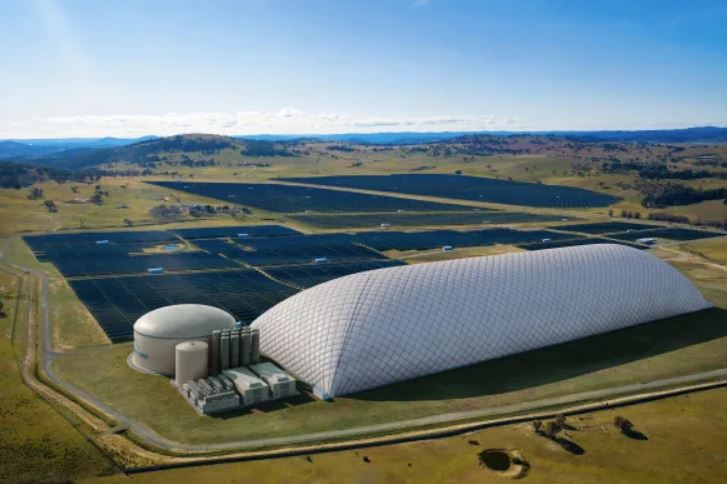
Carbon dioxide is usually discussed as an emission to eliminate. Energy Dome is using it for a different purpose: as the working fluid in a system that stores electricity and releases it later.
MIT Technology Review included the Milan-based company in its 2026 Climate Tech Companies to Watch coverage, published on 6 October. The publication reports that Energy Dome’s systems can be designed to deliver electricity for up to 24 hours, although the company’s operational or contracted plants currently offer eight or ten hours of storage.
That distinction is central to understanding the technology.
A possible design capability is not the same as the duration demonstrated across an operating fleet. And using CO₂ in a battery is not, by itself, carbon removal.
The business significance lies in the ability to move electricity from periods when it is available to periods when it is needed.
How the system stores electricity
Energy Dome’s process combines gas compression, liquid storage and heat recovery.
During charging, electricity powers compressors that turn gaseous CO₂ into a liquid held in storage tanks. The system captures heat generated during compression.
During discharge, the stored heat helps convert the liquid CO₂ back into gas. The gas passes through a turbine to generate electricity and returns to the dome, ready for another cycle.
The CO₂ therefore circulates through the storage process. The technology’s central function is electricity storage, rather than the permanent sequestration of atmospheric carbon.
MIT Technology Review also notes that the system does not require the specific underground geology associated with some compressed-air storage installations. That may broaden the range of locations where it can be deployed, although it does not remove the need to assess land, connections and project economics.
Why duration matters
Energy storage is not a single product category with one universal specification.
A project’s value depends partly on how much electricity it can deliver and how long it can sustain that output. An eight- or ten-hour system addresses a different operating requirement from a battery designed around a shorter discharge period.
Energy Dome’s first commercial plant began operating in Sardinia in 2025, according to MIT Technology Review. The facility has 200 megawatt-hours of storage capacity—enough, the publication reports, to supply approximately 18,000 Italian homes for ten hours.
For procurement teams, the relevant question is not simply whether a project has a large capacity number.
It is whether its discharge profile matches the hours when electricity is most valuable to the customer or the power system.
This is especially important when assessing how renewable generation, storage and electricity contracts might work together.
The efficiency trade-off must remain visible
Longer duration does not eliminate energy losses.
MIT Technology Review reports approximately 70% round-trip efficiency for Energy Dome’s process, compared with roughly 90% for lithium-ion batteries. Round-trip efficiency measures how much of the electricity used to charge a system can subsequently be recovered.
In simplified terms, a system operating at 70% round-trip efficiency would return about 70 units of electricity for every 100 units used to charge it.
Energy Dome estimates that its technology is around 10–15% cheaper than lithium-ion for an eight-hour system, with stronger economics at longer durations. Those are company estimates reported by MIT Technology Review, not a universal cost advantage established for every location or operating pattern.
A lower equipment cost and a lower charging-to-discharge efficiency can coexist.
The investment case therefore needs to examine charging prices, discharge value, operating frequency, financing costs and contractual performance—not simply the headline price of the installation.
An operating plant is not an operating pipeline
The technology has commercial evidence, but its deployment scale remains limited.
MIT Technology Review reports one operational commercial project and a pipeline of approximately 30 gigawatt-hours across five continents. The publication also describes a June 2026 agreement with Google for a 200 MWh facility in Ireland, expected to enter operation in 2028.
A planned project is not delivered capacity. A commercial agreement is not an operating record.
For investors, that means the next phase of evaluation should focus on repeatable execution: construction performance, operating availability, maintenance requirements and delivery against guarantees.
A pipeline can show opportunity. It cannot substitute for evidence from commissioned assets.
The emissions outcome depends on the configuration
The name “CO₂ battery” should not be mistaken for a guarantee of zero-emissions electricity.
MIT Technology Review describes a version of Energy Dome’s system paired with natural-gas turbines. That configuration uses turbine waste heat instead of internal heat storage to help evaporate the CO₂. It can improve the storage process’s efficiency, but the associated gas turbines still produce greenhouse-gas emissions.
This reinforces a broader principle: storage must be assessed within the complete energy system.
Businesses should ask how it is charged, what equipment it is paired with and what evidence supports any emissions claim.
What this means for business energy procurement
Energy Dome’s installations are grid-scale infrastructure, not a plug-and-play battery recommendation for every SME.
However, the underlying procurement lesson is relevant to cold-storage operators, food businesses and other electricity users: energy strategy should consider the timing of supply and demand, not only annual consumption.
When assessing storage-backed supply or renewable-power proposals, businesses should ask:
Which hours of demand does the arrangement cover?
What output and availability are contractually guaranteed?
Who pays for charging electricity and storage losses?
How are renewable attributes and emissions claims documented?
What happens if the storage asset is unavailable?
Does the proposed arrangement still work under different electricity-price scenarios?
These are evaluation questions, not a recommendation that every business should own storage infrastructure.
Energy Dome’s significance is that it makes the long-duration storage discussion more tangible. Its commercial promise now needs to be tested through additional operating projects, transparent performance data and credible contracts.
The central question is not whether CO₂ can be given a new technological role. It is whether the system can deliver dependable electricity at a competitive cost—and with an emissions outcome that stands up to scrutiny.