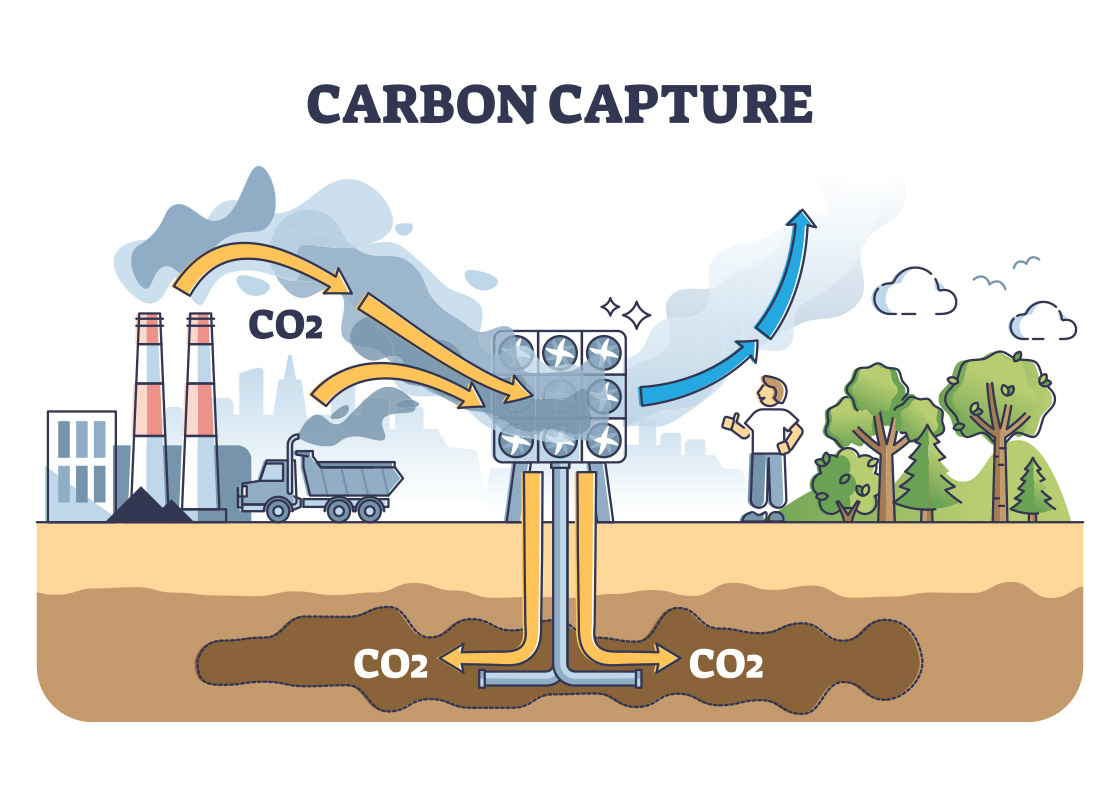
Carbon capture is often described as if the principal challenge is separating carbon dioxide from an industrial gas stream.
That challenge is real.
But in practice, the conditions inside a working industrial facility make it far more difficult than a simple chemistry problem.
Flue gas can be hot, wet, contaminated and variable. It can contain water vapour, sulphur compounds, nitrogen oxides, particulates and other substances that interfere with capture processes. Equipment must work reliably for years, not just under controlled laboratory conditions. The energy required to regenerate capture materials can determine whether a technology is commercially viable.
One persistent challenge is humidity.
Water in industrial exhaust streams can compete with CO₂ for the same binding sites inside capture materials, reducing performance and increasing the energy needed to remove the captured carbon dioxide.
New research from Oregon State University offers an interesting approach to this problem.
Scientists have developed a metal-organic framework, or MOF, called BVR-X, designed to separate the internal pathways used by water and carbon dioxide. In effect, the material directs water and CO₂ to different regions within its pores, allowing carbon dioxide capture to continue under humid conditions. The researchers have filed a patent application, and the results were published in Angewandte Chemie.
It is an encouraging technical development.
But it is also a reminder that successful carbon capture depends on much more than an improved material.
Why humidity matters
Many carbon-capture materials work well in dry laboratory conditions.
Industrial emissions rarely arrive dry.
Cement kilns, steel plants, refineries, power facilities, chemical plants and waste-to-energy sites produce gas streams with different temperatures, pressures, moisture levels and contaminants. A material that performs well under one set of conditions may perform poorly under another.
Water is particularly challenging because it can:
Occupy the same pores or binding sites needed for CO₂
Change the structure of a capture material over time
Increase the energy needed for regeneration
Affect gas-flow characteristics
Create corrosion or operating issues in downstream equipment
Reduce capture efficiency in fluctuating real-world conditions
The Oregon State work is aimed directly at this problem.
The BVR-X material is structured so that water and CO₂ preferentially occupy different regions. According to the research team, this internal organisation allows the material to work in conditions that more closely resemble humid industrial emissions.
That is a meaningful design principle.
It is not yet a deployed industrial solution.
What metal-organic frameworks can offer
MOFs are crystalline materials made from metal ions and organic linking molecules.
Their appeal lies in their highly tunable pore structures.
Researchers can adjust the size, chemistry and arrangement of pores to target particular molecules. This makes MOFs promising candidates for gas separation, hydrogen storage, water capture and CO₂ removal.
For carbon capture, an ideal material would:
Capture a large amount of CO₂
Select CO₂ over nitrogen, water and other gases
Operate at realistic temperatures and pressures
Require little energy to regenerate
Remain stable after many cycles
Be affordable to manufacture at scale
Resist degradation from impurities
Be safe and practical to use in industrial equipment
No single material perfectly satisfies every criterion.
This is why MOF research is exciting but still early-stage. A new structure can solve one performance limitation while creating another challenge involving cost, durability, manufacturing or integration.
The important question is not whether a material captures CO₂ in a laboratory test.
It is whether it continues to capture CO₂ economically and reliably inside a functioning industrial system.
The energy penalty remains central
Carbon capture consumes energy.
A capture system may require electricity, steam or heat to separate CO₂ from other gases and regenerate the capture material. If that energy comes from carbon-intensive sources, the overall climate benefit can be reduced.
This is known as the energy penalty.
A better capture material can potentially reduce that penalty by requiring less energy for regeneration or by maintaining performance in difficult conditions. But the material alone does not determine the result.
Companies need to assess:
The energy required per tonne of CO₂ captured
The source and carbon intensity of that energy
The effect on plant efficiency and output
The availability of waste heat or low-carbon electricity
The full lifecycle emissions of manufacturing and operating the capture system
The emissions associated with CO₂ compression and transport
A carbon-capture project should be judged by net emissions avoided or removed—not simply gross tonnes captured.
Capture is only the first link
A capture material can separate CO₂ from flue gas.
It cannot, by itself, create a climate outcome.
The captured CO₂ still needs to be compressed, transported and either stored permanently or used in a way that is accounted for honestly.
This creates a full-chain test.
Capture
Does the system remove CO₂ reliably from the source, with transparent measurement and manageable energy requirements?
Transport
Can the CO₂ be moved safely and efficiently by pipeline, ship, rail or other infrastructure?
Storage or use
Will the CO₂ be injected into a suitable geological formation and monitored over the long term? Or will it be used in products or processes from which it may later return to the atmosphere?
Verification
Can the project demonstrate the net emissions outcome after accounting for energy use, transport, leakage risk and storage durability?
The more difficult the industrial source, the more important this systems perspective becomes.
The route from laboratory to plant
The history of climate technology is full of promising laboratory results that did not become commercial infrastructure.
That is not a criticism of research. It is the normal pathway of innovation.
Between a new material and a working capture plant lie several stages:
Repeated performance testing
Testing with real industrial gas mixtures
Durability testing across thousands of cycles
Scaling manufacturing processes
Designing contactors, reactors and regeneration systems
Safety and environmental assessment
Integration with existing industrial operations
Cost and energy modelling
Pilot and demonstration projects
Finance, permitting and infrastructure development
At every stage, the original performance advantage can be reduced or strengthened.
This is why public and private support for demonstration matters. The world needs better capture materials, but it also needs engineering, infrastructure, measurement standards and commercial models that can move them into use.
What buyers and policymakers should learn
The Oregon State research is best viewed as a signal of progress in a difficult field.
It suggests that material design can address a practical barrier that has long limited capture performance under humid conditions.
But it should not be used to claim that carbon capture is now “solved.”
For policymakers, the lesson is to support the full innovation chain—from research through demonstrations to shared CO₂ transport and storage networks.
For industrial companies, the lesson is to evaluate capture options against real operating conditions, not idealised laboratory claims.
For carbon-credit buyers and investors, the lesson is to assess lifecycle performance, additionality, energy use, storage and verification rather than relying on the headline technology.
For the public, the lesson is that climate technology is often less glamorous than it appears.
Progress can come from a better pore structure, a lower regeneration temperature, a more durable material or a more accurate sensor. These are technical details, but they can determine whether a technology works at scale.
Better chemistry needs better systems
BVR-X may eventually contribute to more effective carbon capture.
That is valuable.
But the future of carbon capture will not be determined by chemistry alone. It will be determined by whether better materials can be integrated into systems that use low-carbon energy, operate reliably, protect communities, transport CO₂ safely and store it durably.
The science is necessary.
The system is decisive.