Carbon markets are often discussed in the language of tonnes, methodologies, registries and prices.
Those elements matter. Carbon accounting must be credible. Monitoring must be robust. Credits must represent outcomes that are additional, accurately quantified and not double-counted.
But there is another test that is just as important.
Do the people whose land, livelihoods, forests, waters or resources are affected by a carbon project have meaningful rights, voice and remedy?
That question is at the centre of a new joint letter calling for rights-based safeguards in the United Nations’ Article 6.4 carbon-market mechanism. The letter, led by Namati, the Grassroots Justice Network and Carbon Market Watch, was signed by 112 organisations and individuals from 42 countries across five continents.
The intervention is timely.
Article 6.4 has the potential to become an important international framework for carbon crediting under the Paris Agreement. If designed well, it could support climate finance, channel investment toward emissions-reduction and removal activities, and help countries cooperate on climate action.
If designed badly, it could reproduce some of the most persistent failures associated with earlier offsetting systems: weak consent, land disputes, exclusion of local communities, inadequate benefit-sharing and grievance processes that are inaccessible or ineffective.
For a mechanism intended to build global confidence, rights cannot be an afterthought.
They have to be part of the market’s operating system.
What Article 6.4 is meant to do
Article 6 of the Paris Agreement sets out approaches for countries to cooperate in meeting their climate goals.
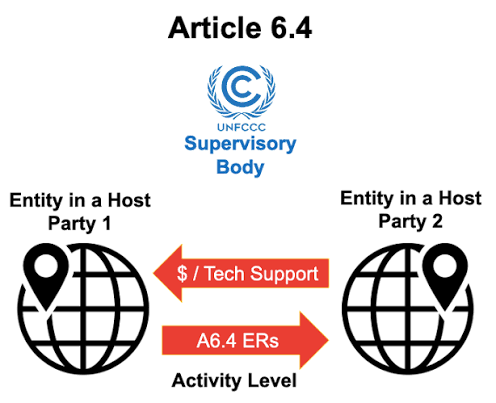
Article 6.2 covers bilateral or multilateral cooperation and internationally transferred mitigation outcomes. Article 6.4 establishes a UN-supervised crediting mechanism intended to support emissions reductions and removals while contributing to sustainable development.
The mechanism is expected to involve project activities that generate units based on verified mitigation outcomes. Those units could potentially be used by countries, companies or other buyers, depending on the rules that emerge.
The stakes are high.
A global crediting mechanism can influence where finance flows, how projects are structured and whose interests are recognised. It can affect land management, energy systems, industrial facilities, agriculture, forests, coastal ecosystems and community development.
That makes governance essential.
A carbon market is not only a trading system. It is a system for allocating money, rights, risks and responsibilities.
Why rights are an integrity issue
The usual language of carbon-market integrity focuses on concepts such as:
Additionality
Permanence
Leakage
Baselines
Monitoring
Verification
Double counting
Registry governance
All are necessary.
But none is sufficient if a project creates conflict, restricts access to land or resources, fails to share benefits fairly or proceeds without meaningful participation.
A project can have sophisticated remote sensing and still be socially fragile.
It can have a detailed methodology and still fail because local people do not support it.
It can issue credits today and face reversal, litigation, reputational damage or loss of social licence tomorrow.
Rights-based safeguards therefore protect more than communities. They protect the climate outcome itself.
Where communities have secure rights, meaningful voice and a fair share of benefits, projects are more likely to have long-term legitimacy and stewardship. Where they do not, the risks are substantial.
For buyers, those risks can become credit risk.
For developers, they can become delivery risk.
For host governments, they can become legal and political risk.
Three foundations for credible safeguards
The joint letter highlights three core pillars for a rights-based safeguards framework.
1. Recognise and protect rights from the beginning
Projects should not begin with carbon calculations and address rights only later.
Human rights, Indigenous Peoples’ rights, customary land rights, labour rights and access to natural resources should be assessed at the earliest stage of project design.
This means asking:
Who owns, uses or depends on the land?
Are there customary or collective rights that are not fully documented in formal land registers?
Could the project restrict access to forests, grazing, fisheries or water?
Are women, young people and marginalised groups represented?
Are there existing conflicts or historical grievances?
What laws, institutions and rights frameworks apply?
A project that treats land as “available” simply because it is not formally titled is already at risk of getting its foundations wrong.
2. Ensure meaningful participation and consent
Consultation is not the same as participation.
A meeting held after key decisions have already been made does not create meaningful consent. A technical document delivered in an unfamiliar language does not create informed participation. A promise of future benefits does not compensate for a lack of choice.
For projects that affect Indigenous Peoples and local communities, free, prior and informed consent should be understood as a process—not a one-time signature.
In practice, that requires:
Engagement before decisions are finalised.
Information that is accessible, relevant and understandable.
Time for communities to discuss proposals independently.
The ability to seek advice and representation.
Participation by groups who may otherwise be excluded.
A genuine option to refuse or negotiate project terms.
Documentation that reflects the process accurately.
The standard should not be whether a developer can prove it held a consultation.
It should be whether people affected by a project had a meaningful role in shaping it.
3. Provide remedy and fair benefit-sharing
Even well-designed projects can create harm or disagreement.
That is why grievance mechanisms are essential. They should be accessible, trusted, culturally appropriate, independent enough to be credible and capable of delivering remedy.
A complaint process that exists only on paper is not a safeguard.
Equally important is benefit-sharing.
Carbon revenue should not flow primarily to intermediaries while communities bear restrictions, risks or opportunity costs. Projects need clear, transparent and enforceable approaches to how benefits are distributed.
That can include:
Direct revenue-sharing arrangements.
Community-development funds with local oversight.
Employment and training opportunities.
Payments for ecosystem stewardship.
Investment in energy, water, health or education priorities identified by communities.
Long-term agreements that outlast the initial crediting period.
The right approach will vary by place. But the principle should be consistent: those who steward or are affected by the project should share fairly in its value.
Safeguards need enforcement, not just language
Most carbon standards already recognise sustainability and stakeholder engagement in some form.
The question is whether these commitments are binding, independently assessed and enforceable.
A credible Article 6.4 safeguards framework should include:
Clear minimum requirements, not voluntary guidance alone.
Independent assessment before registration.
Public disclosure of social and environmental risk assessments.
Monitoring throughout the crediting period.
Accessible, independent grievance and remedy processes.
Consequences for non-compliance.
Protection for human-rights defenders and people raising concerns.
Transparency about project documents, benefit-sharing arrangements and complaints.
Without enforcement, safeguards risk becoming another disclosure exercise: visible in documentation, weak in practice.
The credibility of Article 6.4 will depend not only on what its rules say, but on who can challenge a project when those rules are not followed.
The business case for rights-based markets
Some market participants may see safeguards as additional cost or delay.
That is short-term thinking.
Projects with unresolved rights issues can face costly disruption, legal challenge, community opposition, loss of buyers and reputational damage. They may also be unable to sustain the long-term stewardship necessary for durable carbon outcomes.
By contrast, projects built with fair participation and benefit-sharing can be more resilient.
They can improve trust, reduce conflict, strengthen local monitoring and create stronger incentives to protect ecosystems or maintain project activities over time.
For corporate buyers, rights-based due diligence should be part of procurement.
Questions should include:
Has the project mapped land and resource rights?
Is there evidence of meaningful consultation or consent?
Are benefit-sharing arrangements transparent?
Is there an independent grievance mechanism?
Have social risks been assessed by a credible third party?
Are communities able to access project information?
What remedies exist if harms occur?
A carbon credit should not be considered high integrity if its social foundations are unknown.
A test of the new carbon-market era
Article 6.4 offers an opportunity to create a stronger global benchmark.
The mechanism does not need to repeat the mistakes of earlier market models. It can establish that credible climate finance requires credible governance; that climate outcomes and human rights reinforce each other; and that market integrity includes how people are treated, not just how emissions are calculated.
The alternative is a market that may produce tradable units but fails to earn durable trust.
Carbon markets need finance, methodology and demand.
But they also need legitimacy.
That legitimacy will not come from a registry or a price signal alone.
It will come from ensuring that the people closest to projects are not treated as a risk to be managed, but as rights-holders and partners in climate action.
Sources
Carbon Market Watch: Joint letter—rights-based safeguards in Article 6.4 carbon markets
United Nations Framework Convention on Climate Change: Article 6 of the Paris Agreement
Office of the United Nations High Commissioner for Human Rights: Human Rights and Climate Change
United Nations Declaration on the Rights of Indigenous Peoples
bSustainable Today: The Future of Carbon Markets Is Not Only Carbon