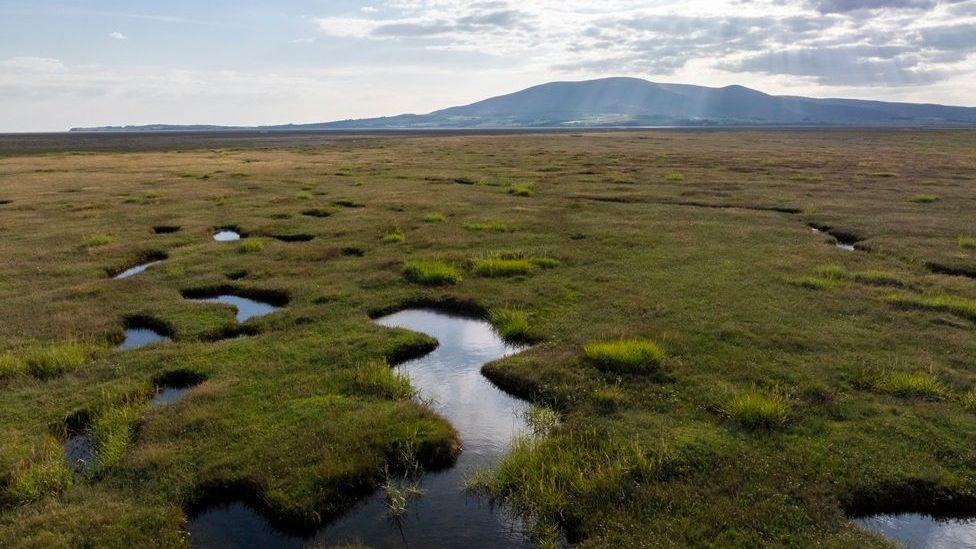
Scotland’s largest saltmarsh has gained a new piece of climate infrastructure.
A gas-flux tower has been installed at Caerlaverock on the Solway Firth to measure how the saltmarsh exchanges carbon with the atmosphere. The project, led by the UK Centre for Ecology & Hydrology with the Scottish Government, NatureScot and WWF-UK, is the first of its kind in Scotland and the northernmost location in the UK Saltmarsh Flux Tower Network.
The tower matters because coastal wetlands are widely described as blue-carbon ecosystems, yet the evidence base for their real-world climate contribution remains uneven.
Saltmarshes can store significant amounts of carbon in vegetation and sediments.
They can also reduce coastal flood risk, support biodiversity and improve water quality. But the size, direction and durability of their climate benefit depend on local conditions: sediment supply, tidal regime, erosion, vegetation change, hydrology, sea-level rise, land management and disturbance.
The Caerlaverock tower will improve the evidence.
It will not, by itself, prove that the saltmarsh has generated a market-ready carbon credit.
That distinction is essential.
What the flux tower measures
A flux tower measures the exchange of gases between an ecosystem and the atmosphere.
In a saltmarsh, the system typically combines high-frequency measurements of wind speed, wind direction and atmospheric gas concentrations with local weather data.
Researchers use these data to estimate net carbon dioxide exchange.
The approach is commonly referred to as eddy covariance.
Rather than measuring individual plants or collecting occasional samples, eddy covariance captures the turbulent movement of air above an ecosystem. This allows scientists to estimate whether the landscape is, over a defined period:
Taking carbon dioxide out of the atmosphere
Releasing carbon dioxide to the atmosphere
Switching between uptake and release as seasons, tides, weather and ecosystem processes change
This is valuable because annual carbon balance cannot reliably be inferred from a single vegetation survey or a one-off sediment sample.
A saltmarsh may absorb carbon dioxide during periods of strong plant growth, then release carbon through decomposition, respiration, erosion or disturbance. A flux tower helps reveal these dynamics.
According to UKCEH, data from the Caerlaverock tower will contribute to understanding saltmarshes’ role in climate mitigation and may support their inclusion in the UK greenhouse-gas inventory.
Carbon flux is not carbon stock
One of the most important distinctions in blue-carbon accounting is between carbon flux and carbon stock.
Carbon flux measures movement over time.
For example:
Net ecosystem CO₂ exchange=CO₂ uptake by photosynthesis−CO₂ released through respiration and decomposition
Carbon stock measures the quantity of carbon held in biomass, soils or sediments at a point in time.
A saltmarsh can contain substantial sediment-carbon stocks accumulated over decades or centuries. But a large historic stock does not automatically mean the site is currently removing carbon rapidly. Equally, a site with modest aboveground biomass may be accumulating sediment carbon over time.
For climate accounting, both matter.
Flux data helps identify current exchange with the atmosphere.
Sediment sampling helps assess accumulated carbon and burial rates.
Elevation and hydrological data help assess whether the wetland can persist under sea-level rise.
Methane and nitrous-oxide data help capture non-CO₂ greenhouse-gas effects.
Erosion monitoring helps assess whether stored carbon could be remobilised.
A credible blue-carbon estimate requires a system view.
Saltmarshes can emit greenhouse gases too
Saltmarshes are often presented as unambiguously carbon negative.
The reality is more complex.
Coastal wetlands can exchange several greenhouse gases, not only CO₂. Depending on local water conditions, nutrient inputs and management, they may emit methane or nitrous oxide.
This does not mean saltmarsh restoration lacks climate value.
It means claims should use a full greenhouse-gas balance expressed in carbon-dioxide-equivalent terms.
A simplified accounting approach might be written as:
Net climate benefit=CO₂ uptake+long-term sediment burial−CO₂ release−CH₄ emissions in CO₂e−N₂O emissions in CO₂e−disturbance-related losses
The specific calculations require site-level data, robust emission factors and transparent assumptions.
That is why long-term monitoring matters.
Why the UK inventory needs better data
National greenhouse-gas inventories influence climate targets, land-use policy and international reporting.
If saltmarshes are included in a national inventory, the country needs evidence that is representative, methodologically robust and updated over time.
The Caerlaverock project can contribute to this evidence base.
But one site is not a national average.
Saltmarshes differ by latitude, sediment type, tidal range, salinity, vegetation, management history and exposure to erosion. A monitoring network is therefore more informative than isolated projects.
The UK Saltmarsh Flux Tower Network aims to create comparable data across multiple coastal sites. This can improve understanding of regional variation and make national estimates less reliant on generic international assumptions.
For policymakers, that is important.
Better data can reduce both over-crediting and under-recognition of coastal ecosystem value.
Restoration is not automatically additional
Saltmarsh monitoring can also support restoration finance.
But carbon-market claims require more than evidence of carbon uptake.
A project must generally demonstrate:
Additionality: the restoration or protection would not have happened without carbon finance
Baseline credibility: the counterfactual scenario is realistic
Permanence: stored carbon is likely to remain out of the atmosphere over the claimed period
Leakage control: environmental pressures are not simply displaced elsewhere
Measurement and verification: emissions reductions or removals are quantified with an appropriate method
Rights and safeguards: local communities, landholders and affected groups are treated fairly
No double counting: the same climate outcome is not claimed by multiple parties
A flux tower can strengthen the measurement component.
It cannot, on its own, establish additionality, permanence or ownership.
Those are governance as well as scientific questions.
Coastal resilience is part of the value
The climate value of saltmarshes should not be reduced to carbon alone.
Saltmarsh restoration can provide:
Coastal flood and storm-surge attenuation
Sediment stabilisation
Habitat for birds, fish and invertebrates
Water-quality benefits
Recreational and cultural value
Climate adaptation benefits for nearby communities
These co-benefits can make restoration economically attractive even where carbon revenue is limited.
This is important because blue-carbon projects should not become dependent on a single carbon-price assumption. Their value lies in a portfolio of ecosystem services and resilience outcomes.
A well-designed project can combine carbon measurement with biodiversity monitoring, flood-risk assessment and community engagement.
The tower is a measurement milestone
The Caerlaverock installation is not merely a scientific instrument.
It is a reminder that nature-based climate action needs evidence at the same level of rigour expected from engineered solutions.
Before a saltmarsh is used to support a carbon claim, a policy target or an investment case, decision-makers should understand:
What gases are being measured?
Over what time period?
What land area does the tower represent?
How are tidal, seasonal and weather effects treated?
What sediment carbon is stored and accumulating?
What are the erosion and sea-level-rise risks?
How will monitoring continue over decades?
Who owns the claimed climate outcome?
The tower will not answer all of these questions immediately.
But it makes a better answer possible.
The future of blue carbon should not be built on broad assumptions about coastal wetlands.
It should be built on measured exchange, transparent accounting and long-term stewardship.