Materiality is one of the most misunderstood words in sustainability.
For a large listed company preparing formal sustainability disclosures, materiality may involve detailed impact and financial assessments, stakeholder engagement, governance reviews, extensive data collection and external assurance. For many small and medium-sized businesses, that description is enough to make the exercise feel too expensive, too technical or simply irrelevant.
That would be a mistake.
A proportionate materiality assessment is one of the most useful things an SME can do. It helps a business decide where to focus limited time and resources. It turns broad sustainability requests into a manageable plan. It creates a documented basis for customer questionnaires, tender responses, lender discussions, insurance conversations and future reporting.
The point is not to copy a multinational’s 150-page double-materiality process. The point is to identify the sustainability issues that genuinely matter to your business and the people affected by it—and to show how you reached that conclusion.
For most SMEs, a good materiality assessment can begin with six practical steps.
First: understand what “material” means
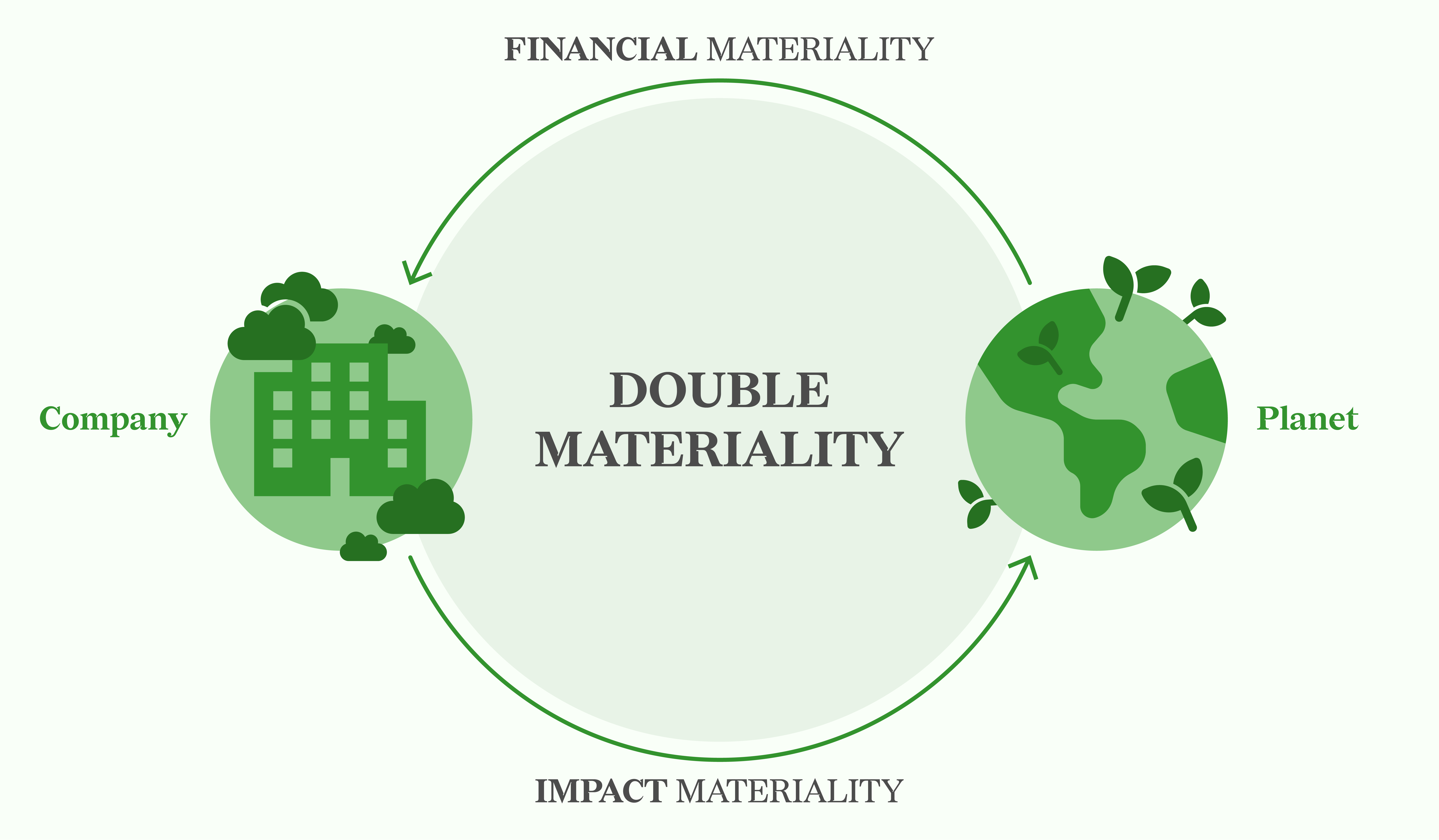
In sustainability, there are two related but distinct questions.
Financial materiality asks: could this issue affect the company’s financial performance, cash flow, access to finance, cost base, asset value, supply continuity or ability to win business?
Examples include:
Rising energy costs.
Flooding or overheating at a site.
A customer requiring supplier emissions data.
Shortages or price volatility in a key material.
New product, packaging or carbon-related rules.
A lender or insurer asking for climate-risk information.
Impact materiality asks: does the company have a significant actual or potential impact on people or the environment through its own operations, products, services or value chain?
Examples include:
Energy use and greenhouse-gas emissions.
Waste, packaging and material use.
Water consumption or local water impacts.
Worker health, safety and wellbeing.
Supply-chain labour practices.
Pollution, biodiversity or land-use impacts.
EU sustainability reporting uses the concept of double materiality, which considers both perspectives. Even if an SME is not in scope for formal CSRD reporting, the logic remains useful: some sustainability issues matter because they affect the business; others matter because the business affects people or the environment; many matter for both reasons.
An SME does not need a perfect scorecard to start. It needs a consistent way to decide what deserves attention.
Second: define the purpose and boundary
Do not begin with a generic list of every possible ESG topic. Start by defining why you are doing the assessment.
For example:
“We need a credible sustainability baseline for customer questionnaires.”
“We are preparing for an upcoming tender.”
“We want to understand our energy, carbon and supply-chain exposure.”
“We need to prioritise sustainability actions for the next 12 months.”
“Our board wants a clearer view of climate and operational risk.”
“We expect future reporting requests from a parent company, lender or major customer.”
Next, define your boundary. For most SMEs, start with:
Your main operating sites.
Your direct workforce.
The products or services you sell.
Your largest suppliers.
Your main customers or customer sectors.
The countries or regions where you operate.
A boundary prevents the exercise becoming unmanageable. You can expand it later.
Third: create a short-list of relevant topics
An SME does not need to assess 50 sustainability topics. A short-list of 10 to 15 is usually enough for a first assessment.
A sensible starting list might include:
Environmental | Social | Governance and commercial |
|---|---|---|
Energy use and carbon emissions | Health, safety and wellbeing | Data quality and accountability |
Climate risk and resilience | Skills, recruitment and retention | Supplier standards |
Waste and circularity | Labour practices in the supply chain | Customer and tender requirements |
Water use or water risk | Community impact | Environmental claims and marketing |
Materials, packaging or product design | Diversity and inclusion, where relevant | Legal and regulatory readiness |
Nature or biodiversity, where relevant | Cybersecurity and responsible technology, where relevant |
The important words are where relevant. A software firm, a manufacturer, a food business, a construction contractor and a professional-services company will not have the same priorities.
Use your business model as the filter.
Fourth: gather evidence, not only opinions
Materiality is stronger when it uses real evidence.
You do not need to commission a large stakeholder survey. Start with the information already available:
Electricity, gas, fuel, travel and waste bills.
Customer questionnaires and tender documents.
Supplier information and contracts.
Health-and-safety records.
Employee feedback and recruitment data.
Insurance renewals, risk registers and business-continuity plans.
Product specifications, packaging data or material bills.
Regulatory notices and industry guidance.
Complaints, incidents or recurring operational problems.
Then speak to a small but useful group of people:
One or two directors or senior decision-makers.
Finance or operations lead.
Procurement lead, if applicable.
An employee representative or a small staff group.
A major customer, supplier or external adviser where appropriate.
The purpose is not to create a statistically perfect survey. It is to test whether the topics identified are real, relevant and supported by evidence.
Fifth: score the topics simply
A straightforward scoring system is usually sufficient for a first SME materiality assessment.
Score each topic from 1 to 5 against four questions:
Business relevance: How likely is the issue to affect revenue, costs, finance, operations, contracts or reputation?
Impact significance: How significant is the company’s actual or potential impact on people or the environment?
Stakeholder importance: How strongly do customers, employees, suppliers, communities, investors or regulators care about the issue?
Urgency: Does the issue require action now, within 12 months, or later?
You can then add the scores or use a simple matrix.
For example:
Topic | Business relevance | Impact significance | Stakeholder importance | Urgency | Priority |
|---|---|---|---|---|---|
Energy and carbon | 5 | 4 | 5 | 5 | High |
Supply-chain labour standards | 3 | 4 | 4 | 3 | Medium-high |
Water use | 2 | 2 | 2 | 1 | Low, unless site or sector exposure changes |
Packaging circularity | 4 | 4 | 5 | 4 | High |
Employee wellbeing | 4 | 4 | 4 | 4 | High |
The scores are not a substitute for judgment. They make the judgment transparent.
Sixth: turn findings into an action plan
A materiality assessment has little value if it ends in a spreadsheet.
For each high-priority issue, define:
The action to take.
The accountable owner.
The evidence or metric to collect.
The target date.
The decision that the information will support.
For example:
Material issue | First action | Owner | Evidence | Timing |
|---|---|---|---|---|
Energy and carbon | Build a 12-month energy and fuel baseline | Operations / finance | Bills, meter data, fuel records | 90 days |
Customer ESG requests | Create an evidence pack | Commercial / sustainability lead | Policies, carbon data, supplier information | 60 days |
Supply-chain exposure | Map top 20 suppliers by spend and risk | Procurement | Supplier list, country, materials, questionnaire | 120 days |
Climate resilience | Review flood, heat and supply disruption exposure | Operations / board | Insurance, site data, risk register | 120 days |
This is the point where materiality becomes a management tool rather than a reporting exercise.
What has changed for SMEs
The direction of travel is clear even as formal reporting rules are being simplified in some jurisdictions.
The European Commission has adopted a voluntary sustainability-reporting standard for SMEs, designed to give smaller businesses a proportionate framework for responding to sustainability-information requests. The standard is also intended to limit the information that larger companies can ask of smaller value-chain partners. That does not remove the need for evidence. It makes a focused, reusable evidence pack more valuable.
In the UK, the Sustainability Disclosure Technical Advisory Committee and UK Sustainability Reporting Standards agenda point toward more financially material, decision-useful sustainability information. For many SMEs, the immediate commercial driver will still be customers, lenders, insurers and procurement processes—not a direct legal reporting obligation. But those audiences increasingly expect businesses to explain their main risks, actions and data.
The practical response is not to wait for perfect rules. It is to create a disciplined baseline that can be updated as requests evolve.
Common mistakes to avoid
A useful SME materiality assessment avoids five traps:
Starting with a framework rather than the business. Use frameworks as reference points, not as a reason to collect irrelevant data.
Treating stakeholder engagement as a box-ticking exercise. Ask focused questions of people who understand the business and its impacts.
Confusing a topic list with prioritisation. The value lies in deciding what comes first.
Ignoring financial implications. Energy, water, carbon, supply-chain, workforce and resilience issues often affect cost, revenue and risk.
Making claims that the evidence cannot support. Record assumptions, sources and limitations.
A credible first version is enough
Materiality is not a one-off verdict. It is a process that should improve as the business gathers more evidence, changes suppliers, launches products, enters new markets or faces new customer expectations.
For an SME, the first goal is not perfection. It is a credible, documented and useful starting point.
A two-page assessment, a clear prioritisation table and a 12-month action plan can be more valuable than a complex report that no one uses.
The businesses that will be best prepared for future ESG requests are not necessarily the ones with the longest disclosures. They are the ones that understand what matters, can explain why, and have evidence that supports their next decision.