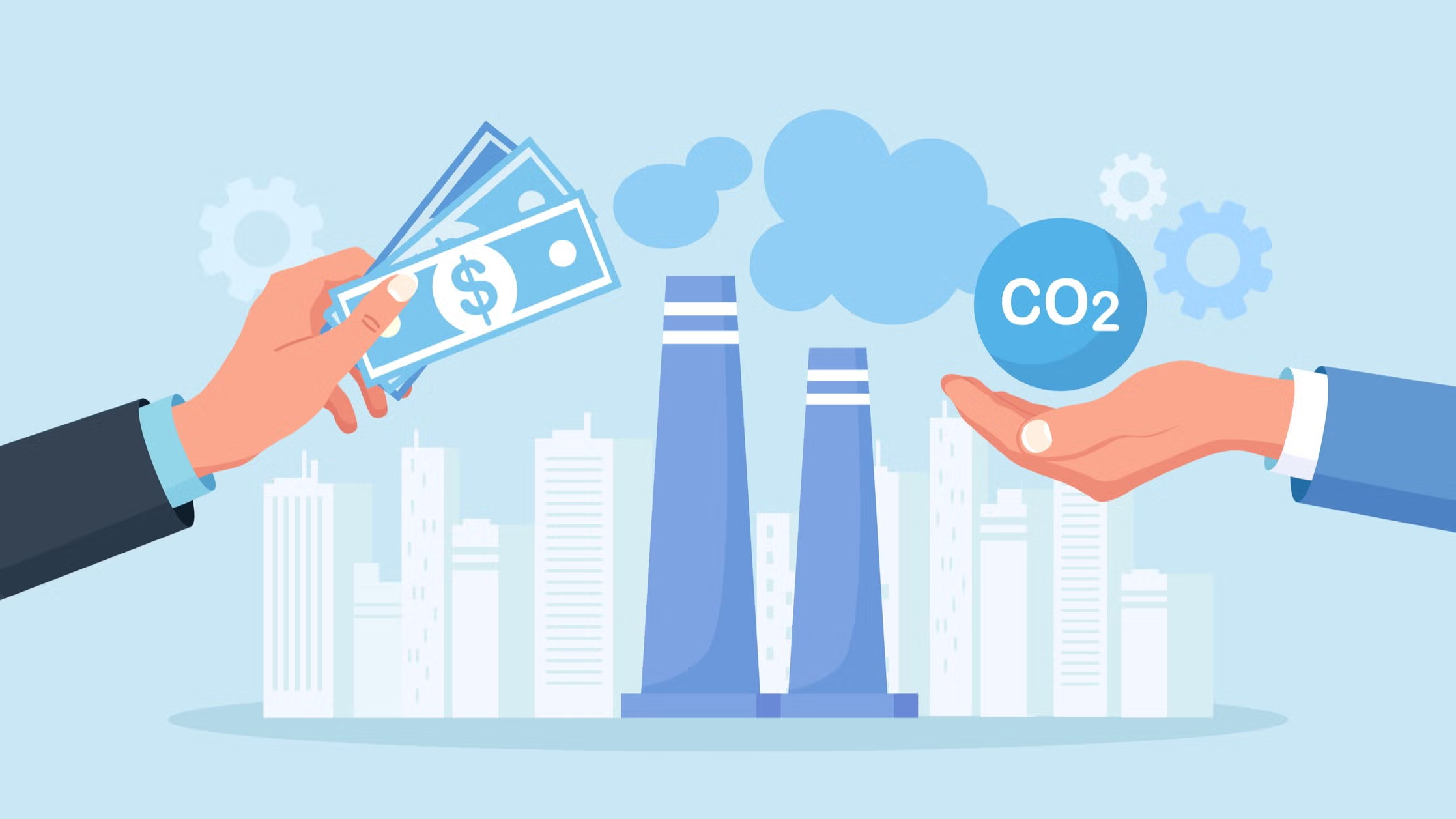
A carbon price is often presented as a simple policy tool.
Put a cost on greenhouse-gas emissions. Encourage businesses to reduce them. Let the market drive investment toward cleaner technologies.
In practice, carbon pricing is never only about the price.
It is also about what governments do with the money.
Revenue from carbon taxes, carbon fees and emissions-trading systems can be recycled into industrial decarbonisation, energy affordability, household support, clean-technology innovation, infrastructure, worker transition, climate adaptation or public budgets.
Those choices determine whether a carbon-pricing system is seen as a credible transition mechanism, a competitiveness risk, a fiscal tool or a political burden.
New analysis from the Grantham Research Institute at the London School of Economics, examining revenue-use options for Taiwan’s evolving carbon-fee regime, makes this point clearly. The effectiveness of carbon pricing depends not only on the charge faced by emitters, but on the design, governance and strategic use of the revenue it generates.
For businesses and investors, this is becoming increasingly important.
The carbon price affects costs.
Revenue use affects the transition pathway.
Why carbon revenue matters
Carbon pricing creates a financial signal.
If emitting carbon carries a cost, businesses have a stronger incentive to improve energy efficiency, switch fuels, redesign products, invest in clean technologies and reduce waste.
But the signal can create pressures.
Energy-intensive industries may face higher operating costs. Households may see higher energy or transport bills. Smaller businesses may struggle to finance upgrades. Regions dependent on high-carbon employment may face economic disruption.
Revenue recycling can address these pressures while strengthening the transition.
A government can use carbon revenue to:
Fund energy-efficiency upgrades
Support clean manufacturing and industrial electrification
Reduce electricity costs or network charges
Provide targeted support for low-income households
Invest in public transport and clean mobility
Finance workforce retraining
Support climate adaptation and resilience
Accelerate research, development and commercialisation
Help smaller businesses access transition finance
The principle is straightforward:
Carbon price+well-governed revenue use=stronger transition capacity
A carbon price without a credible revenue strategy may increase costs without building the capability needed to reduce them.
The industrial-policy question
The debate over carbon pricing is increasingly becoming a debate over industrial policy.
Governments are competing to attract investment in clean manufacturing, low-carbon materials, batteries, hydrogen, renewable energy, carbon capture, grid infrastructure and circular-economy systems.
Carbon-market revenue can help fund those priorities.
For example, revenue can be directed towards:
Electrifying industrial heat
Supporting low-carbon steel, cement and chemicals
Reducing the cost of clean electricity
Developing grid and storage capacity
Financing carbon-capture infrastructure where appropriate
Supporting innovation in hard-to-abate sectors
Protecting workers and communities during industrial transition
The choice is not simply whether to impose a carbon cost.
It is whether carbon revenue will help businesses invest in the solutions needed to reduce future exposure.
This is particularly important for industries facing international competition. If carbon pricing increases domestic costs without providing investment support, companies may argue that production will move to jurisdictions with weaker climate rules.
If revenue supports credible decarbonisation, productivity and infrastructure, the same policy can help protect competitiveness.
Three broad revenue models
Carbon-pricing systems tend to use one or more of three broad approaches.
Revenue approach | How it works | Main benefit | Main risk |
|---|---|---|---|
General public revenue | Funds are paid into the general government budget | Supports fiscal flexibility | Climate benefits may be difficult to identify or measure |
Household and consumer recycling | Revenue is returned through rebates, tax reductions or energy-bill support | Can protect affordability and political legitimacy | May provide limited direct finance for industrial transition |
Earmarked transition investment | Revenue is directed to climate, energy, infrastructure or industrial programmes | Creates visible links between carbon pricing and decarbonisation | Requires strong governance to avoid inefficient or poorly targeted spending |
No single model is automatically best.
The right balance depends on a country’s energy system, industrial base, income distribution, fiscal position and climate objectives.
But transparency is essential.
Businesses, households and investors need to know where the money goes, who benefits and whether the spending is delivering measurable outcomes.
Lessons for business
Companies often view carbon pricing primarily as a compliance cost.
That is understandable, particularly where energy costs are already high or margins are tight.
However, businesses should also monitor how revenue is being used.
Carbon revenue may create new opportunities through grants, tax incentives, contracts for difference, low-cost finance, public procurement programmes, infrastructure investment or support for innovation.
A manufacturing company may benefit from an industrial-decarbonisation fund.
A logistics business may access charging or fleet-transition support.
A property business may benefit from energy-efficiency incentives.
An SME may find support for energy audits, solar deployment, electrification or low-carbon equipment.
The strategic question is not only:
“What will this carbon price cost us?”
It is also:
“What transition support is being financed with the revenue, and how can we access it?”
Lessons for policymakers
A credible carbon-pricing system needs more than a published rate.
It needs a clear social and economic contract.
That contract should explain:
How the carbon price will evolve
Which sectors are covered
How emissions are measured and verified
How trade exposure and competitiveness will be managed
How households and small businesses will be protected
How revenue will be allocated
How spending outcomes will be reported
How policies will be reviewed and adjusted over time
This matters because carbon pricing is more likely to endure when people can see how it supports jobs, affordability, clean infrastructure and practical transition.
A system perceived as a tax with no visible benefit is politically fragile.
A system connected to cleaner air, lower energy waste, modern infrastructure, regional investment and industrial renewal has a stronger foundation.
Revenue use and market integrity
The way carbon revenue is spent also affects market integrity.
If governments use carbon-market revenue to fund projects that would have happened anyway, the additional climate value may be weak. If money is distributed through opaque processes, public confidence can suffer. If revenue is used to subsidise continued high-carbon activity without credible transition conditions, the policy may delay rather than accelerate decarbonisation.
Good governance therefore requires:
Clear eligibility rules
Transparent allocation criteria
Independent oversight
Public reporting
Measurable performance indicators
Time-bound support
Conditions linked to emissions reductions or resilience outcomes
Regular evaluation of cost-effectiveness
The objective is not to spend every pound, euro or dollar labelled “green”.
It is to direct revenue where it creates additional, measurable and durable transition value.
The bigger picture
Carbon pricing remains one of the most important tools in the climate-policy toolkit.
But price alone is not enough.
A carbon market can create a cost signal. Revenue use determines whether that signal is converted into investment, innovation, resilience and public confidence.
For companies, investors and policymakers, the next phase of carbon pricing will be judged not only by the level of carbon prices.
It will be judged by whether the revenues help build the economy needed for a lower-carbon future.